How Much Enzyme Cleaner You Actually Need: The Arithmetic
Match the liquid to the contamination, then treat six inches past the visible mark in every direction. On a dinner-plate spot that is a real fraction of the bottle, poured rather than misted, and it is the number nobody prints: no manufacturer or trade body we read publishes a cleaner-to-urine multiplier. Use the smell, not the stain, to size the treatment, because the salts spread wider than the pigment.
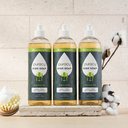
Nobody publishes a multiplier. What is published is the geometry that decides it, and the geometry is why a trigger bottle is the wrong container.
How Much Enzyme Cleaner a Carpet Spot Actually Takes
Match the liquid to the contamination, then treat six inches past the visible mark in every direction.
No manufacturer and no trade body we read publishes a numeric multiplier of cleaner to urine, and we are not going to invent one. What Bridgepoint publishes instead is the geometry. The contaminated area under the carpet may be more than twice the size of the surface stain, and the instruction is to reach the pad and subfloor.
The pour is wide because the deposit is wide. Urine leaves the surface as a cone: it passes through the pile, crosses the backing, then spreads sideways through the pad. The mark you can see is the narrow end of that cone, and treating the narrow end leaves the wide end working.
Treating the mark alone leaves an active ring around the treated circle. That ring holds the same deposit, and it is the part that reactivates first when humid air arrives. The smell comes back at the edge rather than the center, and the center is the part you soaked.
Volume is the dose. With this chemistry there is no concentration you can raise to compensate for liquid that never arrived. A weaker pour held longer is not the same treatment, and a stronger pour that stays in the pile is not the same treatment either. The liquid has to occupy the space the urine occupied.
A fraction of a bottle sounds like a lot next to the trigger-spray habit. It is the amount the deposit sets, and the deposit does not shrink because the package is small. Buy the container that makes the correct pour affordable, which usually means the jug rather than the spray.
| Volume rule | Match the liquid to the contamination, then treat 6 inches past the visible mark in every direction |
|---|---|
| Sub-surface area | May be more than twice the size of the surface stain, per Bridgepoint's own spec sheet |
| Numeric multiplier | Not established. No manufacturer, supplier or trade body we read publishes one |
| Dwell time | 4 to 24 hours on carpet, kept wet, per Bridgepoint Bio-Charge |
| Dilution, concentrates | Bio-Charge 16 oz per gallon of water. |
| Dilution, consumer sprays | Ready to use. Adding water lowers what reaches the deposit |
| Applicator | Pour or inject. A trigger sprayer wets the pile and stops there |
| Water temperature | Not established for a finished consumer product. Keep it out of a heated machine |
Why Spraying an Enzyme Cleaner Does Not Work
A urine spot is not a mark on a surface. It is a cone. Liquid lands on the pile, passes through the backing in seconds, then spreads sideways in the pad, so the wet outline underneath is wider than the one on top.
Enzymes only work where they physically touch the deposit. Protease cuts protein, amylase cuts starch and lipase cuts fats and oils, and each has to reach its own molecule. There is no version of this chemistry that works at a distance.
The second reason is the one almost nobody is told. Most pet products are bacterial rather than enzymatic. Bridgepoint states that a gallon of Bio-Modifier Xtreme carries 200 billion bacteria doubling every 20 minutes under best conditions, and that only happens where the liquid is sitting.
A mist also dries fast. Spray droplets sit on the face fiber, where air moves, and evaporation ends the reaction within the hour. A pour sinks into the assembly, where the liquid is protected and the hours can actually happen.
Both failure modes stack. The mist wets the part of the deposit that matters least, then dries before even that part is finished. The result reads as a product that did nothing, when the product never got a route to the job.
Bacterial products add a timing constraint. The spores have to wake, grow and begin secreting before any cutting starts, and every one of those stages happens in liquid. Spray the surface and the population never establishes where the deposit is.
The spray bottle shapes behavior as much as chemistry. Nobody empties a trigger bottle into one spot, and the container trains a dose the geometry cannot use. The jug changes the pour by making the correct pour possible.
What You Need to Pour Enough Without Wasting It
The format decides whether you can afford to do this correctly, so buy by the ounce. Every product page prints the enzyme evidence we hold. **Tools:** A measuring jug marked in ounces, a roll of plastic sheet, four white cotton towels, and a longwave UV light.
The jug matters as much as the chemistry. A trigger bottle hides the volume you have used, and the habit it trains is a spray rather than a pour. A measuring jug turns each treatment into a known quantity you can repeat or correct.
The towels are the gauge. Pressing one into the center of the spot tells you whether liquid reached the pad, which your eyes cannot tell you from the surface. White cotton also shows what is coming back up, and color reads as dye rather than as evidence.
The plastic is what converts a pour into a treatment. Uncovered, a soaked spot dries in hours in a warm room, and the reaction stops with it. Covered, the same pour works through the window the method requires.
The UV light defines the treatment area. The visible mark understates the deposit, and treating an understated area is the most common way these jobs fail. Marking the fluorescing edge and then working past it sets the coverage from the contamination rather than from the stain.
Waste runs the other direction from what people fear. The expensive path is a thin pour that fails, followed by another thin pour that fails again, followed by a replaced carpet. Enough liquid, once, at the correct width, is the cheap version of this job.
How to Work Out the Volume for Your Own Spot
Work the area first and the ounces follow. Do not start pouring until you know how wide the treatment has to be.
The order exists because each step sets the input of the next. The survey sets the area, the area sets the ounces, the ounces set the package you buy, and the pour only works if all three happened in that sequence.
Measuring beats estimating. A spot judged by eye comes in small, and a treatment sized from a small judgment is small everywhere: narrow, light and short. A tape measure and a chalk line remove the optimism from the arithmetic.
Pouring from the center outward has a mechanical reason. Liquid driven inward from the edge can trap deposit in the middle, while liquid spreading from the center carries the treatment ahead of it to the edges you marked. Work with the direction the deposit traveled rather than against it.
The towel press at the center is the completion test. It tells you the liquid arrived at the deepest part of the deposit rather than sitting in the pile. Damp means keep pouring. Soaked means the geometry is satisfied and the dwell can start.
The cover and the hours are not extras added to the pour. They are the conditions under which the pour does anything at all, and skipping them returns the spot to the state it was in before you started.
Room temperature is the last input, and it belongs to the room rather than the bottle. The bacteria work in a living-temperature range, and a cold room holds the whole treatment below it. Warm the room first and the survey starts with the conditions already correct.
-
Let the room reach normal living temperature and wait 30 minutes before you survey it.
30 minutes
-
Turn the lights off, sweep the floor with a longwave UV light, and chalk a line 6 inches outside the outer edge of every patch that fluoresces.
6 inches
-
Measure the marked circle.
22 inches across
-
Buy the size that lets you pour.
128 ounces
-
Pour from a jug, starting at the center and working out to the marked line.
1 jug
-
Press a folded white towel into the center after 30 seconds.
30 seconds
-
Cover the whole treated circle with plastic sheet.
1 plastic sheet
-
Leave it 4 to 24 hours.
4 to 24 hours
How Big the Urine Area Under the Carpet Really Is
The trade rule is volume matched to contamination. Jeff Cross puts it in Cleanfax as recreating the crime, and spells it out as adding as much deodorizer as there is contamination present in the carpet and pad.
So the honest answer to how much is a procedure rather than a figure. Find the real edge, add six inches, treat that whole area to the point of standing wetness, and accept that the number of ounces is whatever that takes.
Depth is invisible from the surface, which is what makes it the dominant failure. A carpet can look clean while the pad under it holds most of the original deposit, and every judgment made from above reads the top layer only.
The professionals see the underside. They lift carpet on working days, and the pattern they describe is the one the geometry predicts: a small surface mark over a wide, loaded pad. Owners see the mark and size the treatment to it.
Twice the surface area is the floor of the error, not the ceiling. The pad spreads liquid sideways without resistance, and repeated accidents at the same spot stack deposits that merge underneath into one wide reservoir.
Sizing the pour to the visible mark treats the smallest part of the problem. Sizing it to the fluorescing edge plus margin treats the whole one. The difference between those two areas is the difference between a smell that stops and a smell that pauses.
The geometry also prices the bottle. A deposit twice the width of its mark drinks twice the pour, and the format that makes the correct pour affordable is the one that removes the instinct to ration. Owners who size the purchase to the visible stain run out of product before the pad runs out of deposit.
How to Tell If Enough Enzyme Cleaner Got In
Three checks, at three different times, and the last one is the only one that counts.
- At 30 seconds:
- Press a folded white towel into the center. A soaked towel means the liquid is moving down. A damp towel means it is sitting in the pile.
- At the end of the dwell:
- Lift the plastic. The carpet should still be visibly wet.
- At 48 hours, in a warm room:
- Shut the room up, let it warm, and put your nose at floor level. Salts pull water back out of humid air at roughly 55 to 75 percent relative humidity, and a cold dry room passes a spot that will announce itself in August.
Each check interrogates a different layer. The towel reads delivery, the plastic reads dwell, and the warm room reads the deposit that survived both. A treatment can pass the first two and still fail the third, which is why the sequence does not end at the pour.
The 30 second test catches the mistake while it is still correctable. Liquid sitting in the pile can be added to. Once the dwell has run dry, the treatment is over and the counting starts again from zero.
The end-of-dwell check is a binary read on the cover rather than the product. Wet carpet means the reaction had its window. Dry carpet means evaporation ended the job early, and any result you judge afterward is the result of a shortened treatment rather than of the chemistry.
The warm-room test reproduces the condition that restarts the deposit. Salts hold the residue, moisture reactivates it, and heat drives the exchange. A room kept cold and dry cannot produce the answer that matters, which arrives in the season you did not test in.
What to Do If the Spot Still Smells After You Poured
Match the symptom to the branch, then run the fix under it. Every branch ends in an action you can run with what you already have.
Read the smell as a symptom before reaching for anything. A treatment that failed carries information about where it failed, and the branch structure turns that information into the next action rather than another guess.
Run the branches in order of cost. The questions that cost nothing settle the questions that cost a bottle, and the questions that cost a bottle settle the ones that cost a floor. Inverting that order is how the same spot absorbs a season of purchases.
The first split is delivery against chemistry. A pour that never soaked the center failed on volume no matter what else happened, and no second product fixes a first product that never arrived. The rinse-and-wait questions come after the delivery question is closed.
Match your own account of the treatment to the branch, not your memory of the label. What went onto the spot, in what order, and how long it stayed wet are the three facts that sort every branch. Most households already know which one they are in before they finish reading it.
One branch match is enough. Running two fixes at once destroys the evidence for both, because a second chemistry laid over a first turns every later judgment into a guess. Take the branch, run its action alone, and judge at the interval the method names.
The tree ends where the bottles stop. Its last actions are structural, and arriving there is the honest outcome of a deposit that no pour was ever going to reach.
-
The spot still smells, and pressing a white towel into the center never produced a soaked towel.
Why: Not enough product reached the mess.
What to do: Re-treat, pouring rather than spraying, out to 6 inches past the visible mark in every direction, until a towel pressed into the center comes up soaked.
-
The carpet was dry when you lifted the cover, or you blotted it up after 10 minutes.
Why: It was removed before the chemistry finished.
What to do: Re-treat and cover with plastic sheet for 4 to 24 hours. Evaporation ends the reaction, not the clock.
-
A steam cleaner, a heated extractor or hot tap water went into that spot.
Why: Heat reached the product. Rocco and Roxie states that the high heat in a steam cleaner can deactivate its biological ingredients.
What to do: Treat cold, dwell, and bring the machine back a day or two later as the removal step rather than the treatment step.
-
Vinegar, bleach, an oxygen cleaner or a disinfectant went down on that spot first.
Why: Something else was applied first.
What to do: Rinse the area with clear cool water, blot dry, then treat. Do not treat on top of a wet oxidizer.
What Not to Do When Pouring an Enzyme Cleaner
- Do not put bleach on a urine spot:
- Hypochlorite meeting the ammonia in urine makes chloramine gas. America's poison centers logged 75,186 chlorine and chloramine exposures between 2015 and 2022.
- Do not treat over an oxidizer:
- Peroxide is the chemical to worry about, not vinegar. The patent literature says plainly that hydrogen peroxide would kill the probiotics in a live bacterial product.
- Do not run it through a heated machine first:
- Rocco and Roxie says the high heat can deactivate the biological ingredients.
- Do not blot it dry at 10 minutes:
- That is the single most expensive habit in the category.
- Do not water down a ready-to-use bottle to make it stretch:
- It is already at working strength.
Every item on that list is something a reasonable person does while trying to help. The list exists because each one either destroys the chemistry you just paid for or spends the window the chemistry needed.
Sequencing causes most of it. The spot has a history, and anything oxidizing in that history is still in the fiber when the pour arrives. The fix is a rinse and a drying interval, not a different bottle laid over the same residue.
Patience errors cost the window. Blotting early and running heat both end the dwell on a timetable the deposit does not follow. The liquid needs its full wet hours, and nothing about the room being tidy changes that.
Dilution errors cost the dose. A ready-to-use product is formulated to work at the concentration in the bottle, and stretching it cuts the treatment twice: less active material, over less time. If volume is the constraint, the answer is a larger package, not a thinner pour.
When to Stop Buying Bottles and Lift the Carpet
If the smell survives three properly executed soakings, the contamination is in the pad, the tack strip or the subfloor, and no bottle reaches a subfloor.
Bridgepoint's own sheet reaches the same wall from the other side. It tells the technician to apply enough to reach the pad and subfloor, then warns in the same paragraph that some subfloors are susceptible to water damage.
At that point the spend goes into lifting the carpet, replacing the pad, and treating and sealing the boards. Mark Cornelius answers the cost objection in three words: "Carpet underlay is cheap."
If a cat has recently started urinating outside the box, see a vet before you buy anything.
Three is a diagnostic threshold rather than a superstition. Below it, failure can still be explained by volume, dwell or prior chemistry, each of which is correctable from a bottle. Past it, the correctable explanations are exhausted and the remaining one is location.
The wall is physical rather than chemical. A liquid poured on carpet travels down through the pile and the pad, and it stops at whatever the subfloor refuses. Urine does not stop there, because it had years, gravity and repeated application on its side.
The spend changes category rather than growing. Money that went to bottles goes to a pad, a tack strip and a seal coat, and each of those acts on the deposit rather than around it. The trade answer about underlay prices the decision honestly.
The medical line comes first when the behavior is new. A cat that has started urinating outside the box is describing a problem a bottle cannot touch, and cleaning an untreated condition only resets the clock on the next accident.
What It Actually Costs to Treat the Spot
The sticker price is the wrong number. Across our catalog on August 19, 2026 the container is what moves the per-ounce price. **Three treatments across a week on an old spot:** 24 to 48 ounces from the same jug, so $7 to $23. **Lifting the carpet and replacing the pad:** Priced per square foot by the installer. Angi and HomeGuide both were unavailable during our dated review, so we are not printing a number we did not read.
Per ounce is the only price that answers a question. A sticker compares two packages; a per-ounce figure compares two treatment plans, because the plan is a volume of liquid and the package is just how that volume ships.
The container moves the number more than the brand does. Trigger formats carry a premium per ounce and physically discourage the pour, so they cost more twice. A jug costs less per ounce and permits the method, which makes it cheaper a third time by reducing failed treatments.
A course of treatments is the realistic unit. Old deposits respond across repeated soakings, and budgeting for one application prices the job at a fraction of itself. The same jug carries the whole course, which is the argument for buying volume once rather than spray repeatedly.
Replacement enters the arithmetic at the threshold, not before. While the deposit responds to liquid, the bottle is the cheap instrument in the house. Once three proper soakings have failed, the comparison flips, and continuing to buy product is the expensive path that happens to feel incremental.
Prices carry their reading dates for that reason. The structure of the comparison survives a price change, and the reader who runs it again with current numbers is running the same decision.
$2.50 to $23 Typical spend on this job
One poured treatment of a single carpet spot takes 8 to 16 ounces. Three treatments across a week on an old spot take 24 to 48 ounces, so $7 to $23. Sizes and prices read from our own catalog on August 19, 2026.
What We Could Not Verify on This Page
What we could not source is the multiplier itself. We searched every manufacturer document, spec sheet and trade article in our research set for a coverage figure tied to urine volume.
The missing multiplier is a hole in the industry rather than in the method. Coverage claims exist for square footage of clean floor, and none of them carries the one variable this job turns on, which is the volume of contamination under the surface.
Acting under the gap is still possible, and the procedure is the action. The geometry is published, the principle is published, and the margin past the fluorescing edge is the working substitute for a figure nobody prints. Precision you do not have can be replaced by margin you can measure.
The absence also sets the shape of honest shopping. A product promising a specific coverage on urine is promising a number its own industry does not publish, and that promise is a marketing statement rather than a specification. Treat it accordingly at the shelf.
The unverified line travels with every pour we recommend. Volume decides the outcome, the area to treat is set from underneath. The reader who marks a real edge and works past it is executing the claim rather than trusting it. That is the strongest form a claim without a number can take.
A number would narrow the pour, and the procedure instead asks for attention at the edge. That trade is acceptable because the failure mode is undershooting rather than overshooting, and margin is the cheaper of the two errors.
| Claim | Source | Tier |
|---|---|---|
| The area of contamination under the carpet may be more than twice the size of the surface stain, and the instruction is to apply enough to reach the pad and subfloor | spec-sheets.interlinksupply.com | Direct or original source |
| A gallon of Bio-Modifier Xtreme contains 200 billion bacteria, which double every 20 minutes under best conditions, and the bacteria produce protease, amylase, lipase and cellulase | spec-sheets.interlinksupply.com | Direct or original source |
| Bio-Charge mixes 16 oz per gallon of water, is covered with plastic so as not to allow solution to dry, dwells 4 to 24 hours, and the mixed solution is used within 10 days | spec-sheets.interlinksupply.com | Direct or original source |
| Bio-Release dilutes 1 to 4 for a room prespray, and 1 to 1 through 1 to 3 depending on dwell time and severity | interlinksupply.com | Direct or original source |
| The trade rule is to recreate the crime by adding as much deodorizer as there is contamination present in the carpet and pad. Jeff Cross, Cleanfax | cleanfax.com | Secondary source |
| Rocco and Roxie does not recommend its product in a steam cleaner because the high heat can deactivate the biological ingredients, and advises 10 minutes fresh, overnight for older spots, a couple of days for deep set-in urine | roccoandroxie.com | Direct or original source |
| Hydrogen peroxide is a natural antimicrobial and formulations combining it with live probiotics would be ineffective because the peroxide would kill the probiotics | patents.google.com | Direct or original source |
| America's poison centers logged 75,186 chlorine and chloramine exposures from 2015 to 2022, with 12,540 emergency department visits, 1,511 admissions and 26 deaths | pmc.ncbi.nlm.nih.gov | Direct or original source |
| Mark Cornelius, IICRC-approved instructor, on weighing the value of the carpet and on carpet underlay being cheap, and on an oxidizer only oxidizing the surface or crust | cleanfax.com | Secondary source |
| Per-room professional odor removal pricing and per-square-foot carpet pad replacement pricing could not be retrieved: angi.com and homeguide.com both was unavailable during our dated review on August 19, 2026 | angi.com | UNVERIFIED |
| EPA Safer Choice will not certify an enzyme-containing product delivered as a spray, because inhaled enzyme is a respiratory sensitizer | epa.gov | Direct or original source |
| Dried urine leaves an alkaline salt residue and those salts absorb moisture from the air, which rewets the deposit and restarts the bacteria. The 55 to 75 percent band is our own practical reading; no critical relative humidity is published for urate. The author of the cited piece sells an enzyme product line | cleanfax.com | Secondary source |
- What we believe
- Volume decides this outcome more than product choice does, and the area to treat is set by what is under the carpet.
- What would change our mind
- A test rig carrying a pad and a subfloor in which a misted application clears aged urine odor.
- What we could not verify
- Any numeric multiplier of cleaner to urine, which no source we read states.
Frequently Asked
How long do you leave enzyme cleaner on?
Four to 24 hours on carpet, kept wet the whole time. That range is Bridgepoint's published dwell for its Bio-Charge trade product. The cover holds the wet in for the whole range, and the range exists because deposits differ. A fresh accident on the surface takes the short end. A set-in mess that reached the pad runs toward the long one, and a second proper soaking is cheaper than a repeat failure.
Do enzymatic cleaners actually work?
Yes, on the job they are for, which is removing the deposit that keeps regenerating the smell. They fail on delivery rather than chemistry. The product cut what it touched and never touched most of the problem.
Can I mix enzyme cleaner with water?
Only if it is sold as a concentrate, and then at the stated ratio. Bridgepoint's Bio-Charge mixes 16 ounces per gallon of water. A ready-to-use consumer spray is already at working strength, and watering it down lowers what reaches the deposit without increasing depth. Concentrates and ready-to-use products also fail differently when stretched. A diluted concentrate at half strength wets the same area with half the working chemistry. A spray used sparingly covers a fraction of the area, which is the deeper failure.
Is baking soda an enzymatic cleaner?
No. It holds odor rather than removing what makes it. The deposit stays in the fiber and the pad, and it pulls water back out of humid air, which restarts the bacteria producing ammonia. Humidity is the test that tells them apart. A baking soda spot announces itself again when humid air rewets the deposit, and a removed deposit has nothing to announce. Wait for the weather and the answer arrives on its own.
More on the same problem in The Science.