How to Get Dog Urine Out of Anything With an Enzyme Cleaner
Wet the carpet six inches past the mark in every direction, cover it, and leave it overnight. The two steps people skip are the volume and the cover, and skipping either one wastes the bottle rather than the bottle failing. Dog urine is the forgiving case: no cat-specific sulfur chemistry, and the same method that fails on a spray-only pass works the first time when it is poured and covered.
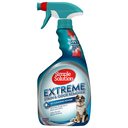
Dog urine is the easier of the two pet smells. It is also the one people under-treat, because the mark on top is smaller than the deposit underneath.
What Gets Dog Urine Smell Out of Carpet for Good
Pour an enzyme or bacterial cleaner until the carpet is wet 6 inches past the mark, cover it, and leave it overnight. The two steps people skip are the volume and the cover. Dog urine is the more forgiving pet case. Cats add a compound dogs do not make, which becomes the sulfur smell everybody recognizes. A dog spot is mostly the ammonia note plus salt, so volume decides it more than dwell does. If you caught it wet, blot first.
Forgiving does not mean automatic. The ammonia note and the salt are ordinary deposit chemistry, and the pour and cover method handles ordinary deposit chemistry well. What it cannot survive is the spray-only pass, because the deposit under the backing never meets the product. Volume first, cover second, and the forgiving case behaves.
Blotting first is half the treatment on a fresh accident. A towel under your weight lifts the liquid that has not yet reached the pad, and every ounce that leaves in the towel is an ounce the pour does not have to chase. Work from the outside in so the blot pushes nothing outward.
The six inch margin exists because the mark is the floor's view of the accident, not the deposit's. Liquid spreads in the backing and the pad as it goes down, and the surface mark is the middle of that spread rather than its edge. Pour to the tape, and judge the pour by the towel test rather than by the outline.
Two failures account for most of the letters this page answers. A pour that stopped at the mark leaves a ring that answers every humid week, and a treatment that dried in an afternoon never let the biology start. Both are fixed with the same two objects, a bottle and a sheet.
| Dwell, carpet | 4 to 24 hours kept wet, per Bridgepoint's Bio-Charge instruction sheet |
|---|---|
| Dwell, consumer spray | 10 minutes fresh, overnight for older spots, a couple of days for deep set-in urine, per Rocco and Roxie |
| How much to pour | Enough to wet the carpet 6 inches past the visible mark in every direction, and enough to reach the pad |
| Dilution | Consumer sprays are ready to use. Nature's Miracle says no dilution. |
| Water temperature | Never through a steam cleaner. Rocco and Roxie says high heat deactivates its biological ingredients |
| Room temperature | The variable that matters. Dropping a room from 68F to 50F slows growth roughly twentyfold in a Bacillus cereus model run in liquid whole eggs |
| Product pH | Nature's Miracle's 2017 SDS gives pH 6.6 at 20C. |
| Surface compatibility | Carpet, pad, subfloor and upholstery: pour. |
Why Dog Urine Keeps Making Ammonia After the Puddle Is Gone
A deposit is sitting there and bacteria are turning it into fresh ammonia every day.
The factory never closes on its own. Water arrives from the air, the bacteria wake, and the ammonia starts again, which is why the smell returns with weather rather than with use. Nothing in the cycle runs out until the deposit does, and the deposit does not run out on any schedule you can wait out.
- Urea:
- The compound carrying most of the nitrogen in urine, and the one bacteria convert to ammonia.
- Urease:
- An enzyme carried by bacteria already on the floor and on the dog, which splits urea into ammonia.
- Salt:
- Urine dries to a salt deposit, and salts pull water back out of humid air at roughly 55 to 75 percent relative humidity.
- Protein and cell debris:
- The fraction a protease cuts, and the fraction that feeds a bacterial product.
- Not uric acid:
- A dog's liver converts uric acid to allantoin, and uric acid has no smell of its own.
Every item in the list points at the same fix. The urea, the protein and the debris are solids waiting for water and chemistry, and the salt is the mechanism that keeps supplying the water. Remove the solids and the cycle has nothing left to convert.
Most pet products are dormant Bacillus spores rather than enzymes in the bottle. PLOS ONE puts germination at minutes and outgrowth at roughly 1 to 2 hours, with secretion after that. Blot dry at 10 minutes and you ended the process before a single enzyme existed.
The schedule is why the method keeps repeating the word cover. Everything in the organism's timeline happens while the spot is wet, and every common mistake ends the wet early. The cover is not an accessory to the pour. On a bacterial product it is the pour's only chance.
What You Need to Treat a Dog Urine Spot
Three things decide the outcome and only one is the bottle. **Enough product:** A dinner-plate spot takes 8 to 16 ounces, a quarter to a half of a 32 ounce bottle. **A cover:** Plastic sheet, a trash bag or a wrung-out towel, overhanging the wet area by 3 inches. **White cotton towels:** A colored towel can transfer dye into wet carpet. **A UV flashlight, 365 to 395 nm:** For finding the spots you have not found. Buy the largest size the job needs. Rocco and Roxie Stain and Odor Eliminator holds Carpet and Rug Institute Seal of Approval SOA101247 through March 31, 2027. It is the only such product in a program listing 153 certified solutions.
The ounces line is the budget the whole page runs on. A dinner-plate spot at 8 to 16 ounces per treatment makes a 32 ounce bottle two to four treatments, not a season of them. Price the habit rather than the accident: a dog that repeats one corner makes the jug the honest size.
The cover can be improvised and cannot be skipped. A trash bag and painter's tape do the same job as purpose-made sheeting, because the physics is a vapor barrier, not a branded product. A wrung towel works while it stays wet itself; a dry towel wicks the water out and ends the dwell early. Whatever covers the spot, the edges overhang and get weighted, because the center holds wet longer than the edges do.
The certification line is worth a sentence of reading. A program listing 153 certified solutions with one pet product in it is a narrow field, and the mark says the product did what its category claims on carpet. It says nothing about the pour, the cover or the hours, which stay the reader's half of the work.
How to Use an Enzyme Cleaner on Dog Urine, Step by Step
This is written for carpet, pad and subfloor. On hardwood, laminate, leather or a mattress, standing liquid is the hazard rather than the method, and the sequence changes.
The sequence is short because the failures are predictable. Blot removes what water can lift, tape makes the deposit's true border visible, the pour replaces the deposit with working liquid, the cover holds the reaction open, and the extraction ends it on purpose. Each step fails in one known way, and the failure tree names each one.
Overnight is the practical dwell because the range is long. Four hours clears a fresh small spot and a day holds an old deep one, and a night under plastic sits inside the range with no attention needed. Treat the range as permission rather than as a deadline.
The three soaking ceiling counts only soakings that passed the towel test and held wet. A misted pass or an uncovered afternoon did not happen as a treatment, and counting it is how a working method gets abandoned. Three honest attempts answer the question the page exists to answer: the deposit is in the carpet, or under it.
Room temperature is the last quiet variable. The range in the steps is specified at normal warmth, and a cold closed room in winter sits below where the spores care to work. A heated room for the pour, a fan for the drying, and nothing that blows hot air at the wet carpet in between.
Repeat treatments are cheaper than big first ones when the spot is old. A pour, a night and a verdict, again, tells you more than one heroic flood and a guess. The method scales with the deposit rather than with the worry.
-
Blot everything still liquid.
1 blotting pass
-
Find the real edge with a UV flashlight in the dark and mark 6 inches outside it with tape.
6 inches past the mark
-
Pour rather than spray, until a folded white towel pressed hard into the center comes up soaked.
8 to 16 ounces
-
Cover the wet area with plastic sheet overhanging by 3 inches and weight the edges, so the solution cannot dry.
3 inches of overhang
-
Leave it 4 to 24 hours, the range Bridgepoint specifies for Bio-Charge on carpet. Overnight is the practical version.
4 to 24 hours
-
Extract with a wet vacuum on suction, no heat, then dry with a fan rather than a heater.
1 extraction to dry tank
-
Judge it at 48 hours in a warm closed room with your nose at floor level, and repeat on anything that still reads.
48 hours
-
Stop after three properly executed soakings. Past that the deposit is in the pad, the tack strip or the subfloor.
3 soakings
How Much Enzyme Cleaner a Dog Urine Spot Actually Needs
The professional skew in that count deserves its discount. Most of those comments come from people whose business is lifting carpet, and their standing interest is the conclusion that the pad is gone. The depth claim is still usually right, and both things are true at once, which is why the count is reported with its source attached.
Cleanfax states the trade rule as recreating the crime: add as much deodorizer as there is contamination present in the carpet and pad. That is a volume match, not a multiple, and no authority we found publishes a multiplier.
Volume matching also explains why the pour feels excessive. The urine went down as liquid, spread as liquid, and dried where it stopped. Matching it means sending a comparable liquid volume through the same path, and the hand resists that on instinct. The towel test exists to overrule the instinct with evidence.
The multiplier that is real applies to area. Bridgepoint says the contaminated area under the carpet may be more than twice the surface stain, then tells the technician to reach the pad and subfloor.
Area is where the honest pour is won. Twice the surface stain means the border of the deposit sits well outside the visible mark, and the six inch rule is the working approximation of that spread. Pour to the tape line, and the contamination's own arithmetic takes care of itself.
Match the pour to the path rather than the puddle. The towel test reads the surface, and the surface is the smallest cross-section of the deposit. A pour that stops at the mark leaves the spread underneath dry, and the smell survives a treatment that followed its label perfectly.
How to Tell Whether the Dog Urine Smell Is Really Gone
Nobody in this category publishes a test, so here is one you can run.
The test has a logic: reproduce the worst conditions the floor will meet, then ask the nose. Warmth wakes the chemistry, humidity rewets the salt, and still air lets the smell pool where the reader first noticed it. A test that skips those conditions tests a different carpet than the one the humid season will.
Wait 48 hours after the carpet is fully dry. Warm the room, close it for an hour, then put your nose within 6 inches of the spot. A cold room and a standing sniff will pass a spot that is still contaminated.
Height is the quiet variable in every verification. A closed room lets the smell pool near its source, and a nose at standing height samples air the spot has not reached. Six inches from the fiber is the distance the instruction names and the distance that works.
To get the August answer before August, run a humidifier in the closed room for 2 hours and smell it again. A UV flashlight is a finding tool, not a verification tool.
The humidifier trick is the cheapest humidity you can schedule. A closed room with a humidifier running for a couple of hours rewets the salt the same way a wet week does, and it delivers the verdict before the season does. Two hours is an evening, and the answer it buys is the one the whole method was aimed at.
Why Your Enzyme Cleaner Did Not Work on Dog Urine
Six causes, and the bottle is the last one to suspect. The one that ends the cycle of buying another bottle is the deposit that is now below anything a bottle reaches.
The tree is a ladder out of the bottle aisle. The top rungs are free and instant, a towel and a clock, and the bottom rung is the lift and look that changes the trade. Every rung between them is a fix you already own the tools for.
The most common rung is the first: the pour was light. The towel test catches it during the treatment, and the fix is more liquid rather than a different label. Reading the tree after the shopping trip instead of before it is the expensive order.
The last rung closes the buying cycle, which is why it is stated rather than softened. Below the carpet, the answer is a pad, a tack strip and boards, and the page hands you off to that work rather than to another bottle. The honest exceptions work the same way: they route you to the oxidizer when the deadline asks for speed, and say what the trade costs.
Two branches describe chemistry that arrived before the product did, and they have the same fix: water, suction and time. The rinse costs an afternoon and no money, and it is the only thing that makes the next pour a real test of the product rather than a test of the residue.
The middle branch, the early blot, is the easiest to own and the easiest to fix. Nobody stands over a wet spot for hours by choice, and the cover exists so nobody has to. Plastic does the standing, and the spores get their schedule.
-
It smells the same as before you started, and the carpet dried fast.
Why: Not enough product reached the mess.
What to do: Press a folded white towel into the center with your full weight.
-
You soaked it properly, blotted it up after 10 minutes, and nothing changed.
Why: The product was removed before it had produced any enzyme. Bacillus outgrowth takes roughly 1 to 2 hours before secretion begins.
What to do: Re-treat and cover the wet area with plastic overhanging by 3 inches. Leave it 4 to 24 hours, then extract.
-
You ran a steam cleaner or a heated extractor over it and the smell got worse.
Why: Heat reached the deposit first. Rocco and Roxie states that high heat deactivates its biological ingredients.
What to do: Rinse with cool water, extract, dry fully, then start the enzyme sequence again.
What Not to Put on Dog Urine
- Bleach:
- Bleach on urine is a chloramine hazard rather than a cleaning strategy, and hypochlorite is the fastest way to zero out a protease. It appears 257 times in the same set.
- Ammonia and ammonia-based cleaners:
- Ohio State's Indoor Pet Initiative puts it plainly: the smell may attract the animal back.
- A steam cleaner, first:
- Rocco and Roxie's own sequence is pre-treat, sit overnight, then steam clean a day or two later.
- A rental carpet machine first:
- Rental and store machines appear 158 times, often as the thing that spread the deposit sideways.
The list reads as chemistry, and half of it is arithmetic with a clock. Peroxide and bleach remove the biology outright, heat deactivates it, and acid parks the pH where the enzyme stops. Only the rental machine fails without touching the chemistry, by moving the deposit somewhere larger before the product arrives.
Sequence repairs most of the list. Anything already on the spot gets a cool water rinse, an extraction and a full dry, and the ground is clear again. The rinse is boring and effective, and it is the one step that makes every later purchase worth its price.
The rental machine entry earns its place by failure mode rather than by ingredients. It moves deposit sideways through the wand strokes, and the next treatment inherits a wider, thinner problem that no label anticipated. Map the spot again after any machine pass.
When Dog Urine Stops Being a Cleaning Problem
See a veterinarian first if a house-trained dog has started having accidents indoors. Sudden house-soiling, straining or drinking noticeably more water is a medical question.
The medical gate comes first because it changes what cleaning means. A dog under treatment for a urinary cause repeats the spot on its own schedule, and no pour can outpace a source that keeps refilling. Treat the cause with the vet, run the method on the deposits, and both halves of the problem actually end.
If the smell survives three properly executed soakings, the deposit is in the pad, the tack strip or the subfloor. Lift the carpet, cut out and replace the pad, then treat and seal the boards. Sealing over a deposit you have not removed is a cosmetic fix with a known failure mode.
The lift and look is the hinge between the two halves of the page. Cleaning the carpet in place is the bottle tier, replacing the pad is the second tier, and the corner you pull back tells you which tier you are shopping in. It costs minutes and answers the question three more bottles would only ask again.
Cleanfax gives the cost rule: the cost of odor control should not exceed the cost of replacing the textile.
The cost rule reads simple and lands hard, because dog urine rarely arrives alone. A repeat corner, a puppy month or an old dog with a cause turns one spot into a territory, and the arithmetic of bottles crosses the arithmetic of pad replacement fast. Price the room once, early, and let the ceiling do its work.
What It Costs to Get Dog Urine Out of a Carpet
Three tiers, in the order to try them. **Bring in a professional:** $100 to $700 per room for pet odor removal, averaging about $350. A pet-odor add-on to standard carpet cleaning runs $20 to $40 or more per room, per Angi. **Replace what holds the deposit:** Carpet pad at $0.75 to $1.75 per square foot installed, per HomeGuide, or roughly $110 to $250 for a 12 by 12 room. Both outlets block our dated review, so those figures are reviewed from the cited source.
The order of the tiers is the order of the evidence. The product tier starts tonight, the pad tier announces itself when the lift and look shows staining, and the professional tier is what you buy when the room matters more than the weekend. Each tier is priced before the next one starts, and the cheap one is never skipped.
The pad figure is the number that ends most arguments. New pad for a 12 by 12 room costs less than most whole-room professional treatments, and it removes the reservoir rather than treating around it. When the lift and look shows soaked pad, the arithmetic is not close.
Treat the add-on figure as what it is: an add-on. A pet odor treatment riding on a standard cleaning assumes the standard cleaning is happening anyway, and a standalone odor job starts from the professional band. Read the quote against the work it actually names.
The low figure is one honest treatment of one honest spot. It is the entry fee that answers whether the deposit is in the carpet or under it, and every tier past it is priced against a decision that first bottle already made possible.
$2 to $700 Typical spend on this job
Low end is the product cost of one dinner-plate treatment at our catalog's August 19, 2026 prices. High end is professional pet odor removal per room, $100 to $700 averaging about $350, from Angi's cost guides.
What We Could Not Verify About Dog Urine on Carpet
Three gaps stayed open. No authority publishes a volume multiplier of cleaner to urine, so the instruction is the principle plus 6 inches past the mark. No test rig we could retrieve produces contamination below the carpet.
The multiplier gap is the one readers feel directly. The towel test converts both into a check the reader can run mid pour.
The rig gap is why the category's arguments never land. The competing claims, oxidizer speed and enzyme permanence, are argued from tests that cannot see below the backing, and a rig with pad, tack strip and subfloor would settle it. Until one exists that can be retrieved, the corpus counts and the mechanism carry the page.
What the page stands on is stated and sourced. The dwell range, the spore timeline, the trade volume rule and the corpus counts all carry their origins, and the gaps are named rather than filled. The reader can spend tonight knowing exactly which sentences are ours and which are receipts.
A gap named is a claim restrained. Where the multiplier would go, the page puts a principle and a check the reader can run. Where the rig would go, it puts counts with denominators and a mechanism with sources.
The third gap is the quietest: nobody in the category publishes a verification test, so the page builds one from the conditions the complaint describes. Warm room, closed door, wet air, nose low. Every element traces to a mechanism with a source, which is how a test you can run substitutes for a test you can cite.
| Claim | Source | Tier |
|---|---|---|
| Bio-Charge specifies a 4 to 24 hour dwell on carpet, a 1:8 dilution, and covering the treated area with plastic so the solution cannot dry | spec-sheets.interlinksupply.com | Direct or original source |
| The area of contamination under a carpet may be more than twice the size of the stain on the surface, and the instruction is to apply enough to reach the pad and subfloor | spec-sheets.interlinksupply.com | Direct or original source |
| ODORx Un-Duz-It Unleashed combines oxidizers with enzymes and odor encapsulants, is pH 9.0 ready to use, and specifies a one hour dwell followed by extraction | specs.safetyexpress.com | Direct or original source |
| Rocco and Roxie specifies 10 minutes fresh, overnight for older spots, a couple of days for deep set-in urine, extraction of the excess, and no steam cleaner because the high heat deactivates its biological ingredients | roccoandroxie.com | Direct or original source |
| Nature's Miracle states its products are ready to use and require no dilution | naturesmiracle.com | Direct or original source |
| Nature's Miracle 2017 safety data sheet gives pH 6.6 at 20C | assets.unilogcorp.com | Direct or original source |
| Bacillus spore germination takes minutes and outgrowth to a dividing cell roughly 1 to 2 hours, with full outgrowth at 3 to 7 hours | journals.plos.org | Direct or original source |
| The trade volume rule is to recreate the crime: add as much deodorizer as there is contamination present in the carpet and pad | cleanfax.com | Secondary source |
| Dried urine leaves an alkaline salt residue and those salts absorb moisture from the air, which rewets the deposit and restarts the bacteria. The 55 to 75 percent band is our own practical reading; no critical relative humidity is published for urate. The author of the cited piece sells an enzyme product line | cleanfax.com | Secondary source |
| The cost of odor control should not exceed the cost of replacement of the textile | cleanfax.com | Secondary source |
| Never use ammonia or ammonia-based products on the carpet, because the smell may attract the animal to that area | indoorpet.osu.edu | Secondary source |
| Enzyme dwell in professional practice runs one hour to 24 hours. R. Doyle Bloss is HydraMaster's VP of Marketing and argues against enzymes on labor economics | hydramaster.com | Secondary source |
| Rocco and Roxie Stain and Odor Eliminator holds Carpet and Rug Institute Seal of Approval SOA101247 in the Pet Stain and Odor Remover category, effective through March 31, 2027 | carpet-rug.org | Direct or original source |
| Catalog prices, sizes, ratings and per-product enzyme evidence levels read August 19, 2026 | enzymecleaningproducts.com | Direct or original source |
| Pet odor removal $100 to $700 per room averaging about $350; pet-odor add-on $20 to $40 or more per room. Angi returns HTTP 403 to our dated review, so this is reviewed from the cited source | angi.com | Secondary source |
| Carpet pad replacement $0.75 to $1.75 per square foot installed. HomeGuide returns HTTP 403 to our dated review, so this is reviewed from the cited source | homeguide.com | Secondary source |
| Nature's Miracle Advanced label states do not use on untreated hardwood, leather, suede, silk or wool. Recorded from the label in our August 19, 2026 research read; we did not later source review a label image | naturesmiracle.com | Secondary source |
- What we believe
- Poured to volume and kept wet, an enzyme or bacterial cleaner is the only bottled product that removes what keeps making a dog urine smell.
- What would change our mind
- A rig with a pad, a tack strip and a subfloor showing a peroxide oxidizer at 10 minutes clearing aged urine smell at 30 days.
- What we could not verify
- Any numeric multiplier of cleaner to urine, which no manufacturer or trade supplier states.
Frequently Asked
Do enzyme cleaners really work on dog urine?
What enzyme is best for dog urine?
Protease, which cuts the protein fraction of the deposit. No enzyme cuts urate, and no consumer product we read names a uricase. Most pet products are Bacillus spores that secrete their own enzymes after 1 to 2 hours of outgrowth. The protein fraction is where the smell lives, which is why protease heads the list on pet bottles. Fat and starch matter less here, and a broad blend exists for coverage as much as for need.
Is vinegar or enzyme cleaner better for dog urine?
Enzyme, for a smell that keeps coming back. Vinegar drops the ammonia note within a minute and the deposit that produced it is still there. Do not layer them: let vinegar dry or rinse it out before you soak. Rinsing between them is the whole protocol. Cool water in, blot or extract it back out, let the spot dry, and the enzyme pour starts from a clean page. Skipping that step is how two right products produce one wrong result.
How to make your own enzyme cleaner for dog urine?
The fermented citrus peel recipe makes an acidic, fragrant liquid. We found no published assay of enzyme activity in a home ferment and will not print an activity number for one. The acidity is the second problem, because it works against anything applied afterward. A bottle carries a stated formulation and a known dilution, and the ferment carries neither. That is the gap that matters on a repeat-offender spot.
More on the same problem in Pet Stains.