Why Dog Urine Smell Keeps Coming Back, and What Stops It
The smell came back because the deposit is still there and the weather turned it back on. When urine dries, only the water leaves; the rest stays as salt residue in the backing and the pad, and those salts pull water back out of humid air at roughly 55 to 75 percent relative humidity. The next move is not a different bottle, it is the same bottle in enough volume to reach what the last pass missed. A humid-week test on a dry day is the exception that proves it: same residue, no smell.
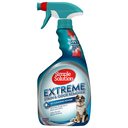
The chemistry is not what failed. Something is still in the pad, and warm humid air turns it back on every summer.
Why the Dog Urine Smell Comes Back on Warm Days
Because the deposit is still there and the weather turned it back on. When urine dries only the water leaves. The rest stays as salt residue in the backing and the pad, and salts pull water back out of humid air at roughly 55 to 75 percent relative humidity.
The next move is not a different bottle. It is treating the area you have not treated. Almost every repeat spot was cleaned at the size of the mark rather than the size of the contamination.
Warmth and humidity are the switch, not the cause. The deposit ran on its own schedule since the treatment, invisible in dry cold air, and the weather changed the conditions around it rather than adding anything to it.
A returning smell is a location report. Whatever is reactivating sits outside the treated volume, and the smell's edge or corner describes where the untreated deposit is. Read the geometry of the return before buying anything.
The treatment that produced three quiet weeks did part of the job. It cleared what it reached, and what it reached was the pile and some backing. The pad underneath kept the bulk of the deposit, and salts there hold it indefinitely.
A new bottle poured at the same narrow width repeats the same partial result. The weeks of quiet between failures make it look like the new product worked before it stopped.
| Most likely cause | The deposit is deeper than the treatment reached. |
|---|---|
| What triggers the return | Warmth and humidity. |
| Retreat volume | Wet the carpet 6 inches past the edge of the area that fluoresces, not 6 inches past the stain you can see. |
| Retreat dwell | 4 to 24 hours, covered, per Bridgepoint's Bio-Charge instruction sheet. |
| Treatments before you stop | Three properly executed soakings. After that it is a pad, tack strip or subfloor job. |
| Expect it to smell worse first | Rewetting a dried deposit remobilizes the smell before anything degrades it. |
| Verdict window | 48 hours after the carpet is dry, in a closed room at normal living temperature. |
| Room temperature | Dropping a room from 68F to 50F slows growth roughly twentyfold in a Bacillus cereus model run in liquid whole eggs, not on a floor. |
What Is Still in the Carpet After You Cleaned It
A treatment that removed the smell for three weeks did real work. It reached the pile and some of the backing, and not the rest.
- Salt residue:
- The bulk of what dried urine leaves, and the part that takes water back out of humid air.
- Urea:
- The nitrogen-carrying compound bacteria convert into the ammonia note.
- Urease:
- An enzyme carried by bacteria already in the pad, which does that conversion whenever the deposit is wet.
- Protein and cell debris:
- The fraction a protease cuts, and the food a bacterial product needs.
- Not uric acid:
- A dog's liver converts uric acid to allantoin, and uric acid has no smell of its own.
Most pet products are dormant Bacillus spores rather than enzymes in the bottle, and PLOS ONE puts outgrowth at roughly 1 to 2 hours before secretion begins.
Each residue plays a role in the return. The salts manage the water, the urea feeds the ammonia note, the bacteria do the converting, and the protein fraction feeds a bacterial product's own population. A treatment that removes some fractions leaves the others employed.
The spore fact changes the timeline of a repeat treatment. Dormant Bacillus needs its outgrowth window before it produces anything. A repeat pour that gets blotted early fails at the same step the first one did, whatever the bottle says on the front.
Depth sorts the fractions. What sits in the pile responds to a spray, what sits in the backing responds to a pour. What sits in the pad responds to nothing smaller than a volume matched to it. The fraction list is also a depth list.
Nothing on the list is exotic. Every item is ordinary chemistry sitting in an ordinary assembly, and every item came from one accident drying in place. That is why the fix is removal rather than counteraction, and why masking products have nothing to act on.
What You Need for a Spot You Have Already Treated
The second attempt needs three things the first one probably lacked. **A UV flashlight, 365 to 395 nm:** To find the real edge, which is wider than the mark and often includes spots you did not know about. **Four to eight times more product:** A dinner-plate spot takes 8 to 16 ounces, a quarter to a half of a 32 ounce bottle. **Plastic sheet and something to weight it:** Evaporation ends the reaction, not the clock. **A wet vacuum:** Suction only, no heat, to pull the loaded solution back out. On a repeat spot buy the jug rather than the trigger bottle.
The second attempt differs from the first in information rather than intent. You know where the edge runs, you know what failed, and the equipment list converts that knowledge into a treatment wide enough and wet enough to test something new.
Multiples of the first product's volume sound like escalation and are arithmetic. A wider circle holds multiples of the area of the mark, and the pour has to keep pace with the geometry or the treatment stays small in a new package.
The plastic and the weight answer the specific way first attempts die. Evaporation, not the clock, ends the reaction, and an uncovered spot on a warm day can lose its window in the time it takes to clean up the towels.
The wet vacuum closes the loop. Once the chemistry has dissolved what it reached, the liquid in the assembly is carrying that load, and extracting it is the removal. Drying in place re-deposits it one layer up, which reads as improvement for exactly as long as the room stays cool.
How to Re-Treat a Dog Urine Spot That Keeps Returning
Written for carpet over pad. On hardwood, laminate or a mattress, standing liquid is the hazard rather than the method.
The rinse step comes before the chemistry because history is still in the fiber. Whatever went onto that spot across months of attempts is resident there, and a new pour lands on that residue unless it is cleared and dried first.
Pouring to the towel test rather than to a plan keeps the volume honest. A repeat spot invites a careful pour, and careful is the wrong instinct: the deposit is wider than the mark. The towel is the instrument that says when the width is actually wet.
Room temperature is a working condition, not a comfort preference. The bacteria in the bottle have a floor below which they stop, and a cold room converts a full dwell into a long pause. Bring the room to living temperature and hold it there for the whole window.
Extraction ends the treatment on the removal step. The dwell is when the chemistry works; the suction pass is when the dissolved load leaves the assembly. Skipping the second half leaves the deposit thinned rather than gone, and thinned deposits come back with the season.
Judging at 48 hours in a warm closed room sets the terms of the verdict. The deposit reactivates under warmth and trapped humidity, and those are exactly the conditions a quick sniff in a cold hallway fails to reproduce.
The stopping rule is three, counted in proper soakings rather than attempts. Half-measures do not count toward it and do not count against it either; the number exists to tell you when the question stops being about bottles.
-
Find the real edge with a UV flashlight in a dark room and tape 6 inches outside every fluorescing area.
6 inches past the edge
-
Rinse any prior chemical out first with clear cool water, then blot and let it dry before you treat.
1 clear-water rinse
-
Pour rather than spray until a folded white towel pressed hard into the center comes up soaked.
8 to 16 ounces
-
Cover the wet area with plastic overhanging by 3 inches and weight the edges, so the solution cannot dry.
3 inches of overhang
-
Leave it 4 to 24 hours, the range Bridgepoint specifies for Bio-Charge on carpet. Overnight is the practical version.
4 to 24 hours
-
Bring the room to normal living temperature and keep it there through the dwell, because a cold room slows the bacteria.
68 F room temperature
-
Extract with a wet vacuum on suction, no heat, then dry with a fan rather than a heater.
1 extraction to dry tank
-
Judge it at 48 hours in a warm closed room at floor level. Stop after three properly executed soakings.
48 hours
How Much Enzyme Cleaner a Repeat Spot Needs
More than the first time, and over a wider area. Cleanfax states the trade rule as recreating the crime: add as much deodorizer as there is contamination present in the carpet and pad.
Bridgepoint's instruction sheet says the contaminated area under the carpet may be more than twice the size of the surface stain. It then tells the technician to reach the pad and subfloor. Urine passes through the backing in seconds and spreads sideways.
Run the arithmetic on your own spot. A circle 10 inches across becomes 22 inches across once you add 6 inches on every side, which is roughly 2.6 square feet instead of 0.55.
Nobody publishes a multiplier of cleaner to urine. We searched manufacturer labels, trade supplier sheets and the restoration press and found none.
The area arithmetic dominates the volume question. Adding a margin around the whole edge multiplies area rather than adding to it, because margin applies in every direction at once, and circles grow faster than their diameters suggest.
A repeat spot is also a mapped spot. The first treatment told you where the smell survives, and that knowledge plus the light gives a boundary you can trust more than the mark. Size the pour from the boundary and the margin, never from the mark alone.
The multiplier gap pushes the decision to geometry. With no published ratio of cleaner to urine, the working substitute is the trade principle plus a measured edge plus margin. It is slower than a number and more honest than an invented one.
Expect the repeat pour to feel excessive. It is the first pour sized to the actual deposit rather than to the visible one. The difference between those two areas is the whole story of why the smell returned.
How to Tell Whether the Smell Is Gone or Just Paused
The test that matters uses warmth and humidity, because those are what bring it back.
Wait 48 hours after the carpet is fully dry. Close the room, bring it to normal living temperature, leave it an hour, then put your nose within 6 inches of the spot. A cold ventilated room passes a spot that is still contaminated.
To force the answer, run a humidifier in the closed room for 2 hours and smell at floor level.
Expect the first hours after treatment to smell worse. Nature's Miracle says the same in its own FAQ: the scent is most intense when the product is first applied. A spike at hour one is evidence the liquid reached the deposit.
The pause is designed to feel like success. A cold dry week after treatment suppresses the exchange that makes the smell, and the calendar fills with quiet days that carry no information about the deposit.
Warmth first, humidity second, floor level always. The test conditions stack the same variables that summer stacks. The nose belongs within inches of the spot because the volatiles are heavier than the room and live at the bottom of it.
The early spike is a delivery report rather than a failure. Liquid reaching a dried deposit releases what was held there before anything has been cut, and the hours after a pour smell like the accident that started the job. A treatment with no spike may not have arrived.
Read the verdict once, at the interval, under the conditions. Sniffing daily produces noise, and noise gets treated as data, and data drives purchases. The schedule exists to protect the reader from the schedule.
Why the Second Treatment Failed Too
Five branches, each ending in an action. Four of them are recoverable and the fifth is the one that ends the cycle of buying bottles.
A second failure narrows the question. One failure implicates everything: volume, dwell, chemistry, depth. Two failures with the same result close the variables that were held constant and leave the ones that were not.
Sort your own treatment against the branches before deciding anything ran out. The questions are mechanical: how much liquid reached the center, how long it stayed wet, what went down before it, and what the weather did afterward. Each answer routes to one branch.
Change one variable per round. A second attempt that widens the pour, switches products and adds a machine simultaneously proves nothing about any of the three. A third attempt built on that evidence inherits all the noise.
The recoverable branches cost liquid and patience. They describe treatments that ran short of width, of wet hours or of a clean start, and every one of those is a repeatable fix with the same bottle.
The structural branch ends the bottle conversation. When the deposit has moved below the assembly a pour can load, the purchase decision becomes a pad decision, and the smell was never going to vote differently.
Trust the stopping rule when you reach it. The branches that recommend more product also describe what more product would have to accomplish, and comparing that description against three failed soakings is the honest version of the decision.
Both readings cost nothing to run, which is the property that makes a stopping rule usable.
-
It smells the same after the second treatment and the carpet dried fast.
Why: Still not enough liquid, over too small an area.
What to do: Re-treat 6 inches past the fluorescing edge until a pressed towel comes up soaked, then cover and hold 4 to 24 hours.
-
You poured plenty and blotted it up after 15 minutes.
Why: The treatment ended before any enzyme existed. Bacillus outgrowth takes roughly 1 to 2 hours before secretion begins.
What to do: Re-treat, cover with plastic overhanging by 3 inches, and leave it overnight before extracting.
-
It clears for a week or two and returns on the first humid day.
Why: The deposit is in the pad, the tack strip or the subfloor, below anything poured on carpet.
What to do: Stop buying bottles. Lift the carpet, cut out and replace the pad, then treat and seal the boards.
What Not to Do to a Spot That Already Failed Once
- Do not reach for baking soda:
- It holds smell rather than removing what makes it, and it leaves grit in carpet. Baking soda appears 207 times in the same set.
- Do not use ammonia:
- Ohio State's Indoor Pet Initiative is direct: the smell may attract the animal back.
- Do not run the machine first:
- Rental machines appear 158 times, often as the thing that pushed the deposit sideways.
- Do not judge it while the room is cold:
- A cold room hides a bad spot and slows the product, because bacteria have a floor temperature below which they stop rather than slow.
Stacking products is the instinct failure creates, and it is the one that locks the failure in. Each added layer changes the conditions the next treatment lands in, and the spot accumulates a chemistry history nobody can reconstruct from memory.
Baking soda feels safe because it is inert, and inert is the problem. It holds smell without touching the deposit, and the grit it leaves sits in the pile through every later treatment, cushioning contact between liquid and fiber.
Machine-first fails by spreading. Wand strokes drive liquid sideways through the pad, and a spot becomes a plume, which raises the area that later needs treating and lowers the concentration everywhere.
Judging in a cold room fails the verdict rather than the treatment. The deposit reads quiet below its reactivation range, the bacteria in the pour read slow at the same temperatures. Both readings point to more bottles when they should point to a thermometer.
Why Your Dog Keeps Peeing in the Same Spot
An enzyme cleaner removes the cue. It is not a repellent and the manufacturers do not claim it is. Block the area physically until the smell test at 48 hours comes back clean.
Ammonia-based cleaners smell like urine to the animal, which is the specific reason Ohio State tells owners never to use them on carpet.
The cue survives at concentrations a human nose calls nothing. A dog reads residue long after the smell has dropped below your floor-level test, and the spot advertises itself to the animal it belongs to.
Removal is the deterrent strategy, and it is the honest one. No product in this category claims to repel. The mechanism that would carry such a claim is the same one that carries the smell, which is the deposit you are removing.
Physical blocking bridges the gap between treating and verifying. The animal cannot re-mark a surface it cannot reach, and the smell test at the interval decides whether the barrier comes down or the treatment repeats.
Ammonia cleaners write the cue back onto the spot. To a dog the note reads as urine, which is why the trade guidance names it specifically. A cleaned spot treated with it is a re-marked spot from the animal's side of the room.
The re-marking loop also closes faster than the smell does. A dog reads the spot long after the human nose calls it clean, and each new accident reloads the deposit the treatment was removing. Breaking the loop takes the barrier and the calendar together: block the spot, treat on schedule, verify at the interval, and release the room only when the test comes back quiet twice. The weeks of discipline cost less than one more round of product on a spot the dog still owns.
Whether to Retreat the Spot or Replace the Pad
The threshold is three properly executed soakings: poured to volume, covered, left 4 to 24 hours, and extracted. If the smell is back on a warm day after the third, the deposit is in the pad, the tack strip or the subfloor.
At that point the work is physical. Lift the carpet, cut out and replace the pad, treat the exposed boards, then seal them. Sealing over a deposit you have not removed prevents later cleaning from reaching it.
Cleanfax writes that the cost of odor control should not exceed the cost of replacing the textile.
- Retreat it properly:
- $5 to $15 of product for one spot done twice at volume, or $37.49 for a jug covering a room. Catalog prices read August 19, 2026.
- Bring in a professional:
- $100 to $700 per room, averaging about $350, per Angi.
The threshold counts soakings, not purchases. Properly executed is the qualifier that makes the number mean anything, and each of its conditions is checkable: poured to wetness at the center, covered, held for the window, extracted.
Below the threshold, retreat is the cheap side of the comparison. Product for one spot measured against pad and labor prices out clearly, and the map keeps even a two-spot job on the chemistry side of the line.
Above it, replacement is the treatment. Lifting the carpet does what no pour can, which is expose the deposit, and the sequence that follows acts on it directly rather than reaching for it through layers.
The trade ceiling governs both sides. Odor work that outprices the textile it protects is mispriced, and the same sentence that ends a professional's proposal should end a homeowner's shopping list.
$5 to $700 Typical spend on this job
Low end is the product cost of retreating one spot twice at volume, at our catalog prices read August 19, 2026. High end is professional pet odor removal at $100 to $700 per room, averaging about $350, per Angi.
What We Could Not Verify About a Spot That Keeps Returning
Two gaps stayed open. No authority publishes a numeric volume multiplier of cleaner to urine deposited, so the instruction is the principle plus 6 inches past the fluorescing edge.
And no published test rig we could retrieve produces contamination below the carpet, which is exactly the condition that makes a spot come back.
The multiplier gap is permanent until someone publishes a number, and the working substitute is a principle with a margin. Edge plus six inches plus a towel test is slower to say than a ratio and harder to get wrong.
The rig gap explains why the shelf confidence exists at all. A test that paints soil on a surface and grades it quickly cannot produce the one condition that makes a spot return: a loaded pad under a clean-looking carpet.
Absent measurements change the instruction, not the effort. Nothing on the method side waits for the missing numbers, and the reader's Saturday runs the same with the gaps open.
Treat the extraction gap as a reason to extract rather than a reason to doubt. With no measurement of what suction removes, the conservative move is the one that removes the liquid mechanically and leaves nothing to measurement at all.
The gaps also keep the confidence honest. Where the method is strong we sound strong, and where the evidence runs out we name the edge rather than round past it.
Two behaviors follow from open gaps. Price the pad before the fourth bottle, and judge in the season that produces the smell, because both moves act on what is known rather than on what is missing.
| Claim | Source | Tier |
|---|---|---|
| Bio-Charge specifies a 4 to 24 hour dwell on carpet and covering the treated area with plastic so the solution cannot dry | spec-sheets.interlinksupply.com | Direct or original source |
| The area of contamination under a carpet may be more than twice the size of the stain on the surface, and the instruction is to apply enough to reach the pad and subfloor | spec-sheets.interlinksupply.com | Direct or original source |
| Rocco and Roxie specifies overnight for older spots and a couple of days for deep set-in urine, and does not recommend a steam cleaner because the high heat deactivates its biological ingredients | roccoandroxie.com | Direct or original source |
| Nature's Miracle states the product scent is most intense when first applied, while the organic waste is being broken down | naturesmiracle.com | Direct or original source |
| Bacillus spore germination takes minutes and outgrowth to a dividing cell roughly 1 to 2 hours, with full outgrowth at 3 to 7 hours | journals.plos.org | Direct or original source |
| ODORx Un-Duz-It Unleashed is pH 9.0 ready to use and specifies pouring on, dwelling one hour, then extracting | specs.safetyexpress.com | Direct or original source |
| The trade volume rule is to recreate the crime: add as much deodorizer as there is contamination present in the carpet and pad | cleanfax.com | Secondary source |
| The cost of odor control should not exceed the cost of replacement of the textile | cleanfax.com | Secondary source |
| Dried urine leaves an alkaline salt residue and those salts absorb moisture from the air, which rewets the deposit and restarts the bacteria. The 55 to 75 percent band is our own practical reading; no critical relative humidity is published for urate. The author of the cited piece sells an enzyme product line | cleanfax.com | Secondary source |
| Never use ammonia or ammonia-based products on the carpet, because the smell may attract the animal to that area | indoorpet.osu.edu | Secondary source |
| Aged urine is alkaline and attacks fiber dye directly, and solution carried into the pad wicks back up as it dries and forms a ring. The author is HydraMaster's VP of Marketing | hydramaster.com | Secondary source |
| Rocco and Roxie Stain and Odor Eliminator holds Carpet and Rug Institute Seal of Approval SOA101247, Pet Stain and Odor Remover category, effective through March 31, 2027 | carpet-rug.org | Direct or original source |
| Catalog sizes, prices, ratings and per-product enzyme evidence levels read August 19, 2026 | enzymecleaningproducts.com | Direct or original source |
| Pet odor removal $100 to $700 per room averaging about $350. Angi returns HTTP 403 to our dated review, so this is reviewed from the cited source | angi.com | Secondary source |
| Carpet pad replacement $0.75 to $1.75 per square foot installed. HomeGuide returns HTTP 403 to our dated review, so this is reviewed from the cited source | homeguide.com | Secondary source |
- What we believe
- A smell that returns on humid days is a depth problem rather than a product problem, and the fix is more liquid over a wider area.
- What would change our mind
- A rig with a pad, a tack strip and a subfloor showing an aged spot cleared for 90 days by a surface treatment alone.
- What we could not verify
- How much of a treated deposit an extraction actually removes, for which we found no published measurement.
Frequently Asked
Can enzyme cleaner remove old pet stains?
The smell, yes, with enough volume and hours of wet dwell, and often across two or three treatments. Old marks give up their smell on the treatment's schedule, not the calendar's. Multiple rounds are normal because the deposit went down in layers and each pour works from the wetted edge inward. Treat, dry, verify, repeat is the loop.
Is baking soda an enzymatic cleaner?
No. Baking soda has no enzymes and no bacteria in it. It holds smell rather than removing what makes it, so the deposit stays in the pad and returns with humidity. It also leaves grit in carpet that is hard to vacuum out. The humidity test separates covering from removing. A spot that only smells on damp weeks is still holding deposit, and baking soda did nothing to it. Removal shows up as silence in every weather, and that is the standard to hold the treatment to.
Is vinegar the same as enzyme cleaner?
No. Vinegar is acetic acid and it neutralizes the ammonia note within about a minute, then the deposit that produced it is still in the pad. The minute of relief is the whole of the benefit, and the trade keeps costing. Each vinegar pass wets the deposit again and gives the bacteria another cycle. The enzyme route ends the loop instead of feeding it.
What is the best enzymatic cleaner for pet urine?
The one you buy enough of. A dinner-plate spot takes 8 to 16 ounces and has to stay wet for hours, so the package you can pour from decides more of this than the name on the front does. Size the purchase to the real area and the treatment stops failing for the boring reason. Half the retreating in this category is a first pour that never matched the spread. Enough product, kept wet, is most of the fix.
More on the same problem in Pet Stains.