How to Stop the Litter Box Area Smelling, Including the Two Feet Around It
Treat the floor and the wall, not only the tray. Empty and wash the tray, then wet the tray, the floor two feet around it, and the wall behind it, keeping all of it wet 4 to 24 hours. The tray is the part people clean and the part that smells least, because it gets scrubbed weekly; the tracked granules and spray mist around the box are what hold the odor. Skip nothing with ammonia in it nearby, including the litter itself.
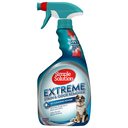
The tray is rarely the whole problem. The floor, the wall and the tray's own scratches are holding what you keep scrubbing off.
What Actually Stops a Litter Box Area Smelling
Treat the floor and the wall, not only the tray. Empty and wash the tray first. Then wet the tray, the floor for about 2 feet around it, and the wall behind it, and keep all of it wet for 4 to 24 hours.
Two feet is not a guess, it is the working radius of the tray. Cats stand at the rim, kick litter as they bury, and shake their paws on the way out, and every one of those actions puts material inside the circle. Treat the circle rather than the stain, because in this room there is rarely a stain to aim at.
The tray is the part people clean and the part that smells least, because it gets scrubbed weekly. What never gets scrubbed is the grout line the cat kicked litter into, the baseboard behind the box, and the floor a standing cat sprayed past.
The never scrubbed list also gives the smell a location signature. A tray smell follows the tray; an area smell stays in the corner when the tray is spotless. A corner that smells with a clean tray is the floor and the wall asking for the treatment.
Before any of that, one question. If a cat that used the box has stopped using it, or has started urinating just outside it, that is a veterinary problem and no cleaning strategy fixes it.
The wash step and the dwell step do different jobs and neither covers for the other. Hot water and soap lift what is loose on the surface, and the enzyme product works the deposit that rinsing cannot reach, in grooves, grout and board seams. A tray that only gets washed keeps its scratches fed, and a tray that only gets product keeps its soap film.
| Dwell on the tray and the floor | 4 to 24 hours, kept wet. |
|---|---|
| Area to treat | The tray, plus a band about 2 feet wide on every open side, plus the wall behind it if the cat sprays |
| Wash first | Hot water and dish soap, then 2 full rinses. |
| Dilution | Ready to use for the consumer hard-floor formulas in our catalog |
| Heat | Hot water is fine for the wash step. Keep heat away from the product itself |
| Litter | Empty the tray completely before treating. Wet litter neutralizes the treatment and wastes it |
| Tray material | Scratched plastic holds the deposit in grooves no liquid rinses out. |
| Time to result | Judge at 48 hours after the area is dry |
Why the Litter Box Area Smells When the Box Is Clean
The smell is coming from three places, and only one of them is the tray.
The split matters because the three places need three different footprints of the same treatment. The tray is small and scrubbed, the floor is wide and rarely wet, and the wall holds a vertical deposit that runs down behind the baseboard. One product, one dwell, three shapes.
- The floor around it:
- Cats standing at the tray edge miss it, kick damp litter out, and track it on their paws. Anything porous within a couple of feet takes the deposit: grout, an unsealed board seam, a rug edge.
- The wall and baseboard behind it:
- An intact male spraying puts urine on a vertical surface at cat height, and painted drywall holds it.
- The tray itself, in its scratches:
- A plastic tray scooped daily for two years is covered in fine grooves, and a rinse does not reach the bottom of one.
Scratches deserve their own sentence because they are invisible in service. A tray under litter looks smooth, and raking light against the empty plastic shows the truth: years of scooping have cut a field of grooves into the floor of it. Deposit sits in the grooves and a rinse passes over the top.
Cats put an enzyme called cauxin into their urine, which releases felinine, and over roughly 12 to 24 hours that breaks down into a sulfur compound. A box area always holds urine between zero and 24 hours old, so the smell is continuously being manufactured.
The continuous manufacture is what separates this room from a one-off accident. A carpet spot is a fixed deposit you remove once, and a box area is a deposit under constant renewal from daily use. The treatment clears the backlog, and the schedule keeps the backlog from coming back.
What to Use on a Litter Box and the Floor Around It
A hard-floor enzyme or bacterial formula, plus dish soap and hot water for the wash step. Two products, not five. Every product page prints the enzyme evidence we hold. Skip the deodorizing litter additives and scented sprays. They add a second smell to the first, and a cat with a strong aversion to a scent will avoid the box. The trade version names hard surfaces explicitly. Bridgepoint's Bio-Charge is a bacteria and enzyme concentrate mixed one part to eight parts water. Its own sheet says it works on carpet, textiles and all colorfast hard surfaces at a four to 24 hour dwell.
The two product rule holds the cost down and the chemistry clean. Dish soap and hot water do the washing, the enzyme product does the dwelling, and nothing else in the cupboard improves either job. Add a scented product and you have added a variable the cat votes on, and cats abstain by finding another corner.
The concentrate math favors the trade format across a year. One bottle mixed one to eight makes a working volume many times its size, and a box area is treated on a schedule rather than once. The ready to use bottle wins on convenience for the first try, and the concentrate wins on the second calendar year.
The evidence line on the product page is the purchase filter. A formula that names its organisms and its purpose on hard surfaces earns the tray job, and a front label with the word enzyme and no back label earns caution. The dwell is the same either way, and the confidence is not.
How to Clean a Litter Box Area, Step by Step
Do the tray and the floor in the same session. Treating one and not the other is why the smell survives.
The session order is empty, wash, map, wet, wait. Emptying comes first because litter absorbs liquid by design and drinks whatever you pour. Washing comes second because product spent on a soap film is product not spent on the tray. The map comes third because the light reads a dry floor.
The tray dwells standing in the sink, and that is the one trick worth stealing. A wet tray left flat dries from the edges in, and a tray standing in its own wet holds the dwell for hours with no attention. The floor runs the same chemistry with a taped edge instead of a tub.
Timing the session for a day at home matters more here than on carpet. Hard floors and walls dry faster than carpet, and the dwell has to be defended with re-wetting rather than a sheet draped on a wall. Plan the hours, not the minutes.
The wall check reads higher than instinct suggests, because spraying is a vertical behavior. Work the light from the baseboard up to the height in the steps and include the baseboard face itself. A spray cat paints a narrow band, and one pass with the light finds the whole band.
The final rinse belongs to the tray alone. The floor dries itself with a fan, and the tray needs the rinse because the cat stands in it with bare paws and then grooms. Product that served its dwell gets taken off the plastic before the litter goes back in.
-
Empty the tray completely and take the litter outside.
0 litter left in the tray
-
Wash the tray with hot water and dish soap, then rinse it 2 full times until no foam is left.
2 rinses
-
Map the floor with a longwave ultraviolet light in a dark room and tape the outer edge of everything that glows.
2 feet
-
Check the wall behind the box up to 24 inches high with the same light.
24 inches
-
Wet the inside of the dry tray completely with the product and leave it standing in a sink or a tub so it cannot dry out.
1 full wetting
-
Treat the floor out to the taped edge, and at least 2 feet on every open side of the box.
20 strokes
-
Keep everything wet for 4 to 24 hours, which is the dwell Bridgepoint specifies for its bacterial additive on colorfast hard surfaces.
4 to 24 hours
-
Rinse the tray, dry it, and let the floor dry with a fan and no heat.
30 minutes
The Step People Skip Around a Litter Box
The two feet of floor on every side of the tray. It is the part nobody treats and the part that is wet most often.
Frequency is the trap. The two foot ring takes a small deposit from every single visit, and the deposits accumulate faster than any weekly wash removes them. Many small deposits against occasional cleaning is the entire smell budget of the room.
Every use of the box puts a small amount of urine and damp litter outside it. A cat that stands rather than squats sprays past the rim, and a cat that scratches flicks wet litter onto the floor.
The second thing people skip is emptying the tray before treating it. Litter is designed to absorb liquid, so it drinks the product and the plastic underneath never gets wet.
The same logic orders the work on the floor. Dry litter on the tile drinks product the same way litter in the tray does, so sweep before anything gets wet. The broom pass is not preparation for the treatment; it is the first step of it.
The third decides whether any of this holds: the product has to stay wet. Most consumer pet products are bacterial, and those spores need one to two hours of outgrowth before they secrete useful enzyme. Wiping a hard floor dry at ten minutes ends the process before it starts.
Ten minutes is exactly the wrong amount of time on this surface. Long enough to look like effort, short enough that nothing biological happened, and the wipe leaves the doer convinced the product failed. The dwell is the product on a hard floor, and nothing shorter substitutes for it.
How to Tell the Litter Box Smell Is Gone
- The 48 hour read:
- Wait 48 hours after everything is dry, put the box back with fresh litter, and smell at floor level with the room closed.
- The ultraviolet recheck:
- Go back over the floor and the wall with the same light. Residual glow is a map of what you missed.
- The tray in raking light:
- Hold the empty tray up to a window at an angle. A field of fine scratches means the tray is holding deposit in the grooves.
- The warm damp test:
- Lay a towel wrung out in warm water on the worst patch for 20 minutes and smell it.
Sequence the checks from cheapest to most telling. The raking light costs a look out the window, the ultraviolet recheck costs a walk to a dark room, the warm towel costs twenty minutes, and the 48 hour read costs patience already spent. Each one narrows the next one's job.
The target is a room that smells of nothing when the box is clean, not a room where a used box is odorless.
That target also protects the cat. A corner that smells of nothing invites the box's use, and a corner layered with scent invites a different choice of corner. Clean and neutral is the goal, and every product decision in the room should be tested against it.
Log the reads for a week after the treatment. A corner that passes on day one and fails on day four is telling you the renewal is faster than the schedule, which is a box count question rather than a product question. The nose keeps minutes if someone writes them down.
Why the Litter Box Smell Came Back
Six causes, and on this surface the first one is unlike the carpet pages, because the tray itself can be the reservoir.
Read the tree with a clean tray and a closed room, because the branches sort by location. Floor branches glow under the light, wall branches smell at standing height, tray branches smell within a day of a wash, and each fix follows from where the answer came.
The tray as reservoir branch has no carpet equivalent, and it is the cheapest branch in the set. A scored tray is a consumable that has stopped being consumable, and replacing it ends a cycle no bottle can. It is the first thing to try after the third wash fails.
The wall branch deserves urgency. Drywall that takes urine through the paint does not give it back to any liquid you can apply, and treating the surface early stops absorption from becoming a renovation. The light check up the wall is a two minute job that can save a repaint.
The branches also have a time signature worth learning. A smell that survives the first hour after the box comes back is location; a smell that takes two days to return is renewal; a smell that never left is depth. Time narrows the tree faster than any single test does.
One branch is a purchase, and it is the cheapest one on the page. Everything else on the tree costs effort the reader already owns. That asymmetry is why the tray branch gets checked early rather than last, whatever the order of the symptoms.
-
The tray is spotless and the corner still smells.
Why: The deposit is in the floor within about 2 feet of the box, in grout, a board seam or a rug edge.
What to do: Map the floor with an ultraviolet light in a dark room and treat everything that glows, keeping it wet for 4 to 24 hours.
-
You treated the tray with litter still in it and nothing changed.
Why: Litter absorbs liquid by design, so it drank the product before the plastic underneath was wet.
What to do: Empty the tray, wash it with hot water and dish soap, rinse twice, then wet the dry plastic and leave it wet.
-
The smell is at nose height rather than floor height when you stand near the box.
Why: A cat has sprayed the wall or the baseboard behind the box, typically up to 24 inches high.
What to do: Check the wall with the ultraviolet light, treat what glows, and expect painted drywall that absorbed urine to need priming and repainting.
-
You have cleaned everything correctly and the tray still smells within a day of a wash.
Why: The tray surface is scored with fine scratches that hold deposit in grooves a rinse does not reach.
What to do: Replace the tray. It is the cheapest item in this decision and it ends the cycle.
What Not to Use Near a Litter Box
- Bleach, which is the dangerous one here:
- Hypochlorite meeting the ammonia in urine produces chloramine gas, and a litter box is the highest-ammonia surface in most houses. America's poison centers logged 75,186 chlorine and chloramine exposures between 2015 and 2022.
- Ammonia, for a second reason:
- Ohio State's Indoor Pet Initiative tells owners never to use it, because the smell can draw the cat to that spot.
- Peroxide and oxygen powders:
- The patent literature is blunt: hydrogen peroxide is a natural antimicrobial and would kill the probiotics.
- Scented masking sprays:
- A scent a cat dislikes drives it out of the box.
- A pour, on a wood floor near the box:
- Standing liquid on wood is damage. Wipe, dry, repeat.
Vinegar gets the narrow version. HERA records that subtilisin proteases are inactivated below pH 4, so rinse it out and let the surface dry before treating.
The bleach entry escalates fastest here, and the location is the reason. A closed bathroom or laundry room, a high ammonia surface, and hypochlorite in a bucket is the exact recipe behind the poison center count. The box area is the last room in the house to improvise chemistry in.
The wood floor warning is the carpet instinct talking. Everything on the pet shelf is marketed with a pour, and a pour on wood near the box is standing liquid against a finish. The wipe, dry and repeat rhythm loses some dwell and keeps the floor, which is the right trade on that surface.
Ammonia based cleaners fail twice in this room, once on the chemistry and once on the audience. The smell hands the cat a signpost to the same corner, and the signpost survives the cleaning. Nothing else on the list manages to advertise while it fails.
When the Litter Box Smell Stops Being a Cleaning Problem
Every entry in the list changes the tool rather than the bottle. Read them in order, because the first two are the fast ones: a vet decides the cause, and a new tray ends the cheapest cycle on the page.
- When the cat's behavior changed:
- New urination outside the box is a vet visit, and in a male cat straining to urinate it is an emergency.
- When the tray is scratched through:
- Replace it. A scored tray holds deposit in grooves no rinse reaches, and it is the cheapest item in this decision.
- When it is the grout:
- Unsealed grout holds the deposit below the surface. Treat it, then seal it, or replace it.
- When the drywall took it:
- Painted drywall behind a spraying cat absorbs through the paint, and that is a primer-and-repaint.
- When there are not enough boxes:
- The behavioral fix outperforms every product here, and it is free.
If the smell is coming from the litter itself between changes, the answer is a shorter change interval and a second box, not a bottle.
The box count entry is the behavioral ceiling of the page. Boxes in more places shorten the radius each one has to defend, spread the daily deposit, and give an unhappy cat somewhere to go. It costs nothing to try and it outperforms every chemical on the shelf.
Litter itself is a substrate, and it is designed to hold liquid. The interval between changes is the only lever that controls how much it holds before it starts returning it to the room. Shorten the interval before shopping, because the bag of litter costs less than the bottle.
- What we believe
- Most litter box odor is in the floor and the tray's scratches, and treating the tray alone is why it keeps coming back.
- What would change our mind
- A measurement showing the tray surface holding most of the odor load in a box area cleaned on a normal schedule.
- What we could not verify
- Any published porosity or odor-retention figure comparing plastic trays with stainless ones.
What It Costs to Fix a Litter Box Area
The cleaning side of this is the cheapest job on the site. One small bottle treats a tray and the floor around it several times over. A replacement tray, an extra box and a shorter litter change interval all cost less than a second round of products. The expensive tier is only reached when drywall or grout has to be replaced.
The numbers stay small because the surfaces stay small. A tray is a square foot of plastic, the two foot ring around it is a few more, and the whole job fits inside one bottle with room to spare. Compare that with a room of carpet and the low ceiling explains itself.
Spend in the order the page argued. The first bottle tests the method, the second tray tests the reservoir theory, the second box tests the behavior, and only then does anything involving drywall or grout enter the budget. Most corners stop smelling at step one or two, which is why the expensive tier stays rare.
The expensive tier is a location verdict rather than a cleaning verdict. Grout and drywall are porous building materials, and once the deposit is under their surface the fix is replacement. The bottle that cleared the tray and the tile has found its edge, and the edge is honest.
The one serious cost in the room is repeating the cheap fixes forever. A bottle a month against a corner that needs a second box is the expensive subscription nobody prices. The tier list exists so the cheap structural fixes get bought before the consumables stack up.
$13.49 to $59.97 Typical spend on this job
One bottle treats the tray and the floor around it several times over.
What We Could Not Verify About a Litter Box Area
Two gaps, named. We found no published comparison of odor retention between plastic and stainless litter trays, so the scratched-plastic argument is physical reasoning rather than a measurement. No manufacturer publishes a dwell time for a plastic tray specifically, so the figure here is the colorfast hard surface dwell from a trade document.
The stainless comparison gap is real because the answer is knowable. Trays are consumable plastic in a category that also sells stainless, and a retention comparison would settle the scratched plastic argument with a number. Nobody we read has run it, so the page argues from geometry: grooves hold, smooth does not.
The tray dwell gap is the same shape as the hard surface gaps everywhere in this set. The document that carries the dwell names colorfast hard surfaces, and a plastic tray is one, so the figure transfers by category rather than by measurement. The reasoning is stated where the reader can reject it.
Neither gap touches tonight's job. The method stands on the wash, the map, the wet and the dwell, all of it sourced, and the unknowns sit in the shopping comparison rather than in the treatment. Buy either tray and the sequence is identical.
Both gaps could close the same way, from a manufacturer or a lab publishing a number, and neither has.
A third small gap rides with the two named ones: no schedule figure exists for how fast a cleaned area re-accumulates, so the page gives a renewal argument rather than a frequency. The fix is observational and free. The reader's nose, kept honest for a week, publishes the local number no source can.
| Claim | Source | Tier |
|---|---|---|
| Bio-Charge is a bacteria and enzyme concentrate that mixes one part to eight parts water, works on carpet, textiles and colorfast hard surfaces, and specifies a four to 24 hour dwell | spec-sheets.interlinksupply.com | Direct or original source |
| Cauxin releases felinine in cat urine, and felinine degrades over roughly 12 to 24 hours to a sulfur compound that is the primary contributor to the odor of cat urine | cell.com | Direct or original source |
| Bacillus spores germinate within minutes and take one to two hours to grow out before meaningful enzyme secretion | journals.plos.org | Direct or original source |
| Rocco and Roxie describes a consortium of non-pathogenic Bacillus spore microorganisms at one billion colony-forming units per gram | roccoandroxie.com | Direct or original source |
| Never use ammonia or ammonia-based products, because the smell can attract the cat back to that area | indoorpet.osu.edu | Secondary source |
| US poison centers logged 75,186 chlorine and chloramine exposures between 2015 and 2022, with household acid meeting hypochlorite causing 48.9 percent of isolated chlorine gas cases | pmc.ncbi.nlm.nih.gov | Direct or original source |
| Hydrogen peroxide is a natural antimicrobial and would kill the probiotics in a live bacterial formulation | patents.google.com | Direct or original source |
| Subtilisin proteases are inactivated below pH 4 | heraproject.com | Direct or original source |
| Nature's Miracle safety data sheet gives product pH 6.25 to 7.5 and withholds the composition as a trade secret | assets.unilogcorp.com | Direct or original source |
| The area must be kept moist and warm for 24 to 48 hours; the cost of odor control should not exceed the cost of replacing the material | cleanfax.com | Secondary source |
Frequently Asked
Can I clean a litter box with enzyme cleaner?
Yes, on an empty, washed, dry tray. Wash with hot water and dish soap first and rinse twice, because detergent film blocks the product from reaching the plastic. A rinsed, dried tray gives the chemistry somewhere to work.
What is the best enzymatic cleaner for cleaning litter boxes?
A hard-floor formula, because you are treating plastic and the floor around it rather than an absorbent assembly. The floor around the box is usually the bigger job. Spray tracks and near-misses land on tile or wood, and those surfaces want a controlled application rather than a soak. Match the format to the surface under the box, not to the tray.
Is white vinegar an enzymatic cleaner?
No. Vinegar contains no enzyme. It neutralizes the ammonia note for about a day and leaves the deposit in the tray and the floor, so the smell returns. The tray's scratches hold deposit the way carpet fiber does, and the smell cycles back the same way. An enzyme product takes that residue apart instead of covering it. Wash, treat, dry is the order that ends the cycle.
Is hydrogen peroxide an enzymatic cleaner?
No. Peroxide is an oxidizer and it works by a different mechanism, destroying color and some odor molecules on contact. That contact mechanism is also the limit. Peroxide brightens and disinfects the surface, and the deposit below a scratch or a seam stays put. For a smell that keeps returning, oxidation pauses it and removal ends it.
More on the same problem in Pet Stains.