How to Get Cat Urine Out of Anything With an Enzyme Cleaner
Pour the cleaner until the material is wet as deep and as wide as the urine went, cover it so it cannot dry, and leave it 4 to 24 hours. Three things make this fail and none of them is the bottle: not enough liquid, letting it dry early, and an oxidizer already in the fiber. Cat urine is the hardest pet case because cats make a sulfur compound dogs do not, which is why the cheap bottle that worked on dog mess can honestly fail here.
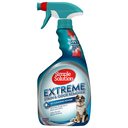
Cat urine is not stronger dog urine. It is a different molecule, it takes about a day to appear, and volume is what decides whether you remove it.
What Gets Cat Urine Out of Carpet, Wood and Fabric
Pour an enzyme or bacterial cleaner until the material is wet as deep and as wide as the urine went. Cover it so it cannot dry and leave it 4 to 24 hours.
Volume is the instruction that carries the rest. The urine moved under gravity and spread in the backing, so the liquid has to arrive in the same shape and something near the same amount. The cover, the hours and the fan all protect the volume you poured rather than replace it.
Three things make it fail and none is the bottle: not enough liquid, letting it dry, and an oxidizer already in the fiber. If the smell survives three proper treatments, it is in the pad, the tack strip or the subfloor.
Counting treatments strictly is what makes the three treatment ceiling honest. A pour that never reached the pad or a dwell that dried in two hours did not happen as a treatment. Only attempts that passed the towel test and stayed wet count toward the three.
On a sealed hard floor the method inverts, because standing liquid is the damage rather than the technique.
The inversion on hard floors is about water tolerance, not chemistry. Carpet is built to be wet and to dry out; finished wood, upholstery and mattresses are not. The pages for those surfaces keep the goal and change the delivery, because a method that ruins the object cleaned the wrong thing.
The three failures have three different tells, which is what makes them findable. A light pour leaves a smell that centers on the mark. A dried dwell leaves a smell that returns as the spot warms. An oxidizer in the fiber leaves a smell that survives everything, because the biology was dead on arrival.
| Dwell on carpet | 4 to 24 hours, kept wet. Bridgepoint specifies that range for its trade bacterial additive |
|---|---|
| Dwell on a sealed hard floor | Not established. No manufacturer document we read names a finished wood or laminate floor |
| How much to pour | Enough to travel as deep as the urine did, and to wet the carpet 6 inches past the mark in every direction |
| Area to treat | At least twice the size of the surface mark. |
| Volume multiplier | None published. |
| Dilution | Ready to use for every consumer cat product in our catalog. |
| Product pH as shipped | Nature's Miracle 6.25 to 7.5, Bridgepoint Bio-Charge 7, ProRestore ODORx Un-Duz-It Unleashed 9.0 |
| Heat | No steam and no heated machine until the removal step. |
Why Cat Urine Is a Different Problem From Dog Urine
Two smells come off that spot, and one of them exists only because a cat made it.
The timing explains a pattern most cat owners meet before they meet the chemistry. The accident happens, the spot looks small and smells of little, and a day later the room announces it. The spot did not get worse while you were away. The smell was assembling itself on its own schedule.
- The ammonia note:
- Bacteria split the urea in the deposit into ammonia. Dogs produce it too.
- The cat note:
- Cats put an enzyme called cauxin into their urine, which releases a compound called felinine. Over roughly 12 to 24 hours felinine breaks down into a sulfur compound, and Miyazaki and colleagues call that the primary contributor to the odor of cat urine.
- Not uric acid:
- Cats convert uric acid in the liver before the urine leaves the body, and uric acid is odorless anyway.
The consequence is a timing rule. Yesterday's accident is chemically worse than the one in front of you now. Fresh is also the one case where an oxidizer beats an enzyme product, because oxidation destroys a sulfur compound on contact.
The oxidizer exception is narrow and worth respecting. It buys speed on a fresh note and leaves the deposit beneath, because oxidizers work at the surface and crust what is underneath. Aged cat urine is past the exception, and the bottle category is the remaining move.
Getting the chemistry right also tells you what the product has to do. The job is removing a deposit that keeps feeding bacteria, not dissolving a crystal, and the sulfur note fades when the deposit is gone.
What Is Actually in the Bottle, and Why It Needs Hours
Most pet products sold as enzyme cleaners are bacterial products, and the manufacturers say so.
Rocco and Roxie describes a consortium of non-pathogenic Bacillus spore microorganisms at one billion colony-forming units per gram. Nature's Miracle says bacteria-based formulas produce enzymes when they meet a food source. Those are dormant spores: germination takes minutes, outgrowth to a dividing cell takes one to two hours, and secretion starts after that.
Blot the area dry at ten minutes and the job ended three steps before the first enzyme existed.
That is the quiet failure inside every one bottle and one towel afternoon. The product gets blamed, the towel looks busy, and no enzyme was ever present. The correction is not a better bottle. It is a cover, and the patience to leave it alone.
Neither market leader names an enzyme. Read the format rather than the front label: a product you can pour, in a size you can pour from.
The hours in the dwell are the schedule of the organism itself. Germination, outgrowth, then secretion, each stage on its own clock and each stage needing the deposit to stay wet. The dwell range the trade sheet specifies is that schedule written for a technician.
Format follows from the organism. A mist lands and vanishes, and a pour travels. The size follows from the format, because pours are measured in ounces per spot and a serious spot takes a serious fraction of a bottle.
The word enzyme on the front label is doing less work than the sentence on the back. When the back says bacteria or spores, you are holding a livestock product, and livestock need hours and water. When the back is silent, assume the livestock and treat it the same way.
What to Buy for Cat Urine, and What Size to Buy It In
Buy the jug. The method starts with the word pour, and a trigger bottle is the wrong package for it. Every product page prints the enzyme evidence we hold. One certification is worth knowing about, because it is the only third-party one in play. Rocco and Roxie Stain and Odor Eliminator holds Carpet and Rug Institute Seal of Approval SOA101247, in the pet stain and odor remover category, through March 31, 2027. You also need a plastic sheet, painter's tape, a longwave ultraviolet light and white towels. The plastic sheet is the cheapest item and the one that changes the outcome.
Read the certification as a third party having tested the product in its category, and read the size and the format as the rest of the decision. It is the only mark of its kind in play here, which is exactly why it gets named.
The jug is not bulk buying, it is one honest treatment of one honest spot. A palm sized mark done properly draws down a 32 ounce bottle fast, and cat urine rarely arrives as a single palm sized mark. The large format also survives the repeat treatments the method asks for.
The towels do double duty in the method. Before the pour they blot what is still wet, and during it they tell you the liquid arrived. White matters because dye hides the answer the towel is giving you.
Match the size to the plan rather than to the accident. A single fresh accident caught the same day is a 32 ounce problem. A territory, a repeat corner or a multi cat household is a jug problem from the first pour, and buying the small bottle first is a tax on optimism.
How to Use an Enzyme Cleaner on Cat Urine, Step by Step
Written for carpet and other absorbent assemblies. Sealed hard floors and moisture-sensitive surfaces take a different method.
The order exists because earlier steps protect later ones. The light finds the true size of the job, the rinse protects the chemistry from what went on before, the pour delivers, the cover protects, and the extraction closes. Run it backward or skip a link, and the strongest step is only as good as the weakest one before it.
The rinse step earns its place even when the spot looks untouched. Anything already in the fiber from an earlier attempt, a spray, a powder, a home remedy, is chemistry the pour has to survive rather than replace. Clear water, fully dried, clears the ground.
Treat the room as part of the tool kit. A closed room at normal living temperature keeps the assembly in the range the biology wants, and a fan afterward does the drying the heater cannot be trusted with.
Blotting comes before rinsing and both come before pouring, because each one is cheaper than the liquid that follows. A towel under your weight lifts what water can already carry. The rinse clears what chemistry someone left behind. The pour is the first step that spends product, and it deserves a clean floor to land on.
The extraction step exists to end the treatment on purpose. Suction with no heat pulls the spent liquid and the broken down deposit out of the pile, and the fan finishes what the suction starts. A spot left to evaporate keeps its chemistry and its water in the carpet, which is how a finished treatment looks like a failed one.
-
Find the full outline with a longwave UV light in a dark room and tape 6 inches outside it in every direction.
6 inches past the mark
-
Blot anything still wet with a folded white towel under your full weight, then repeat on a dry section.
1 blotting pass
-
Rinse out any prior chemical with clear cool water and let it dry before you treat.
1 clear-water rinse
-
Pour rather than spray until a white towel pressed into the center comes up soaked, not damp.
1 towel test
-
Cover the wet area with plastic sheet overhanging by 3 inches and weight the edges.
3 inches of overhang
-
Leave it 4 to 24 hours at normal room temperature, which is the range Bridgepoint specifies for carpet.
4 to 24 hours
-
Extract with a wet vacuum on suction and no heat, then dry with a fan rather than a heater.
1 extraction
-
Judge it at 48 hours in a warm closed room at floor level, and stop after three properly executed treatments.
3 treatments
The Step Almost Everyone Skips on Cat Urine
Covering it. People pour enough, let the spot dry in two hours, and conclude the product does not work.
The cover does one mechanical thing: it stops the water leaving. Under plastic, the liquid you poured stays in the assembly and keeps working, and the reaction ends when you choose rather than when the air decides. It is the only step in the method that hands the schedule back to you.
Evaporation ends the reaction. The clock does not. For a bacterial product that is fatal, because outgrowth alone takes one to two hours. Cleanfax states the field version and its limit together. The area has to be kept moist and warm for 24 to 48 hours, which is difficult to sustain on carpet in the field.
The field limit is worth reading twice. The trade source that specifies a day or two of warmth also admits the field rarely sustains it, which tells you the professional and the homeowner fail the same way. The plastic sheet is the amateur's answer to a professional's problem.
Watch the room, not the bottle. Taking a room from 68F to 50F slows growth roughly twentyfold in a published Bacillus cereus model run in liquid whole eggs.
Cold rooms fail silently, which is what makes them expensive. The pour happened, the cover held, and the organisms sat dormant through the dwell anyway. A thermometer read at floor level costs less than the treatment it protects.
A covered spot also tells you more when you check it. Lift a corner halfway through the dwell and press the towel test again: soaked means the assembly still holds working liquid, and dry means the pour was light. Both answers are worth having while there is still time to act on them.
How to Tell the Cat Urine Smell Is Actually Gone
Test the condition that brings it back rather than sniffing a cold dry spot.
The tests below reproduce the enemy, humidity and warmth, in miniature. A spot that passes them has earned the word gone, and a spot that fails either one has told you where the next pour goes.
- The warm damp test:
- Wait 48 hours after the area is fully dry. Lay a towel wrung out in warm water over the spot for 20 minutes, then smell at floor level.
- The ultraviolet recheck:
- A residual glow is a map of where to pour next.
- The humid day test:
- The verdict arrives on the first warm wet week.
Stain and smell are two jobs on two timescales. The stain sits on the fiber and is judged immediately. The smell lives in the pad and is judged at 24 to 48 hours.
Sequence the tests and let the cheap one speak first. The towel test costs twenty minutes tonight, the ultraviolet recheck is a walk to a dark room, and the humid week arrives on its own. A failed towel test sends you back to the pour before the week has to say it.
Keep the two timescales separate when you judge. A spot can hold a faint mark and no smell, or no mark and a live smell, and only one of those outcomes calls for another treatment. The nose at floor level owns the verdict.
Write down what each test said, because the memory of a smell fades faster than the smell does. A note with a date turns three tests into a trend, and a trend is what tells you the second treatment worked better than the first. The page's verdicts are all reproducible, and reproducible means recordable.
Why the Cat Urine Smell Came Back After Cleaning
Most branches share one spine: the deposit and the product never met at depth. The fixes either push liquid deeper or clear the chemistry that blocked it, and none of them starts with a different brand.
The worse before better branch is the one that panics people into quitting. A rewetted dried deposit releases odorants on the way to being digested, and the spike is evidence the liquid arrived. Abandoning the dwell at the spike keeps the worst of both worlds.
The professional skew is worth remembering while you read. The depth complaint is loudest from people whose living depends on the answer being lift the carpet, and the fix for it is still a bigger pour. Take the diagnosis and do the arithmetic yourself.
Start at the top of the tree and work down with the cheapest evidence you own. The first two branches answer to a towel and a clock, the third to your own nose during the dwell, and the last to a memory of what went on the spot first. Only the pad and the subfloor ask for a lifted corner, and by then the tree has earned the trust.
The tree ends where the method ends, and that is deliberate. A deposit below the carpet is not a harder cleaning problem, it is a different trade, and the honest page hands you off at that line rather than selling you a fourth bottle to throw at it.
-
The smell came back as soon as the carpet dried, or it returns every humid week.
Why: The liquid never reached the depth the urine reached.
What to do: Re-treat at volume.
-
You soaked it properly, then blotted it dry after ten or fifteen minutes.
Why: The product was removed before any enzyme existed.
What to do: Re-treat, cover with plastic, and leave it 4 to 24 hours. Dry it with a fan afterward instead of blotting it.
-
The smell got sharply worse in the first hours after treatment.
Why: You rewet a dried deposit and released the odorants before anything degraded them. That is evidence the liquid reached the contamination.
What to do: Finish the dwell, then dry and extract rather than letting it evaporate in place. Judge it at 48 hours.
-
A carpet machine, an oxygen powder or a peroxide spray went on the spot first.
Why: Oxidizers are the real risk here, and hydrogen peroxide kills a live bacterial product outright.
What to do: Rinse with clear cool water, blot, let it dry, then treat.
What Not to Mix With an Enzyme Cleaner on Cat Urine
- Bleach is the dangerous one:
- Hypochlorite meeting the ammonia in urine produces chloramine gas. America's poison centers logged 75,186 chlorine and chloramine exposures between 2015 and 2022.
- Peroxide and oxygen cleaners waste the product:
- The patent literature is blunt about live bacterial formulas: hydrogen peroxide would kill the probiotics.
- Ammonia invites the cat back:
- Ohio State's Indoor Pet Initiative tells owners never to use it on carpet for that reason.
- Heat, before the dwell is finished:
- Rocco and Roxie says high heat deactivates its biological ingredients.
- A fine mist, in a house with asthma:
- EPA's Safer Choice program will not certify a spray-delivered enzyme product.
Vinegar gets the narrow version. HERA records that subtilisin proteases are inactivated below pH 4, so a fiber still wet with vinegar is a bad starting point. Vinegar is the myth. Peroxide is the problem.
The spray warning is about delivery rather than ingredients. The same formula poured from the same bottle keeps the enzyme out of the air you breathe, and the applicator is the whole difference. In a house with asthma, the choice of applicator is the safety decision.
Bleach carries a second, quieter cost: it strips color while it gases. A spot treated with hypochlorite can come out lighter than the carpet around it, and the trade for that is a smell that survives the treatment. Nothing on the list pays out worse per use.
The sequence that follows from the list is short. Nothing oxidizing, nothing ammonia based, no heat, and a rinse between whatever was there and whatever goes on next. Follow it and the product gets a clean run at the deposit, which is all the chemistry ever asks.
When Cat Urine Stops Being a Cleaning Problem
Every marker below changes the category of the problem rather than the brand of the bottle. Read them as the edges of what cleaning can reach, and treat the first one as the gate the others wait behind.
- When the cat is the reason:
- New urination outside the box is a veterinary question first, every time.
- After three proper treatments:
- Poured to volume, covered, left 4 to 24 hours. Past that the deposit is somewhere a bottle does not reach.
- When it is in the pad or the tack strip:
- Lift the carpet at that spot and replace the pad.
- When the boards under it are black:
- Dark staining in wood is a tannin reaction below the finish, and that is a sanding decision.
- When a floor register sits in the spot:
- Ductwork moves the smell through the house and nothing poured on carpet reaches it.
The register entry is the one nobody expects and the easiest to check. A duct in or near the spot carries the smell to rooms that have no stain in them, and the hunt for the source chases the vent instead of the carpet. Look under the register before the third bottle.
None of the markers is a failure of the method. They are the method finding its own edge, and knowing an edge is cheaper than funding it.
The pad marker has a practical middle path. Replacing the pad under one spot costs less than re-carpeting a room, and a carpet layer can do it in an afternoon. The marker is not the end of the floor, it is the end of the bottle phase, and the two get confused constantly.
- What we believe
- On cat urine older than a day, an enzyme or bacterial cleaner poured to volume and kept wet removes the source.
- What would change our mind
- A test rig with carpet, pad, tack strip and subfloor showing a peroxide oxidizer at ten minutes clearing aged cat urine odor at 30 days.
- What we could not verify
- Any published numeric volume of cleaner per volume of urine.
What It Costs to Remove Cat Urine, in Dollars
The per-ounce price decides this, not the sticker on the front. One serious spot treated properly can take most of a jug. Cleanfax states the rule that should end the spending: the cost of odor control should not exceed the cost of replacing the textile.
Per ounce is the arithmetic that survives contact with the method. The pour does not care what the front label cost, it cares how many ounces come out, and a spot treated three times multiplies whatever the sticker said. Compare sizes on the per ounce number and the right bottle picks itself.
The top of the range is not the product's fault either. Most of a jug into one spot means the spot was deep, repeated or old, and the pour was honest about it. Price the method against the textile early, because the stopping rule does not soften with repetition.
Count the hardware once and stop counting it. The sheet, the tape and the towels outlive many spots and many bottles. The recurring cost is the liquid, and the per ounce figure is the number to watch.
The spread between the small spray and the jug is the method talking. A single treatment fits in the spray, and the method is rarely a single treatment, so the spray price is the entry fee and the jug price is the real one.
Money spent at the edge of the range buys certainty as much as it buys cleaning. The last jug in a three treatment attempt is what tells you the deposit is below the carpet, and that answer ends the spending. A cheaper path to the same answer is the lifted corner, and it is worth taking before the second jug, not after the third.
$11.89 to $59.97 Typical spend on this job
One serious spot treated properly takes most of a 128 ounce jug, and the one pet product we hold in that size ran $37.49 at our catalog prices read August 19, 2026. A 32 ounce ready-to-use spray covers a single treatment. We publish no contractor figure, because Angi, HomeGuide and Fixr all was unavailable during our dated review that day.
What We Could Not Verify About Removing Cat Urine
Three gaps, named. No consumer product we read names its actual enzyme, which is a statement about the documents we read rather than about every product sold. No contractor price appears, because Angi, HomeGuide and Fixr was unavailable during our dated review on August 19, 2026.
The enzyme disclosure gap behaves the same way here as everywhere in the category. A product that will not name its actives cannot be matched to a mess on paper, so the format and the third party marks carry the decision instead. The evidence level on each product page is where we hold that.
The contractor gap has a date attached rather than a shrug. The price aggregators were unreachable on the day we looked, so no professional figure appears, and the page says so rather than smoothing it over. Local quotes fill the gap faster than a national average would anyway.
The gaps do not reach the method. Volume, cover and dwell are specified and sourced, and the unverified items sit around the edges of the job rather than under it.
A named gap can also close, and the enzyme one has a direction. The disclosure lives in documents the companies already write, and publishing it is a decision rather than a discovery. When a market leader names its actives, the evidence level we hold moves the same day.
Read the three gaps together and the page's shape makes sense. The method carries sources, the prices carry dates, and the unknowns carry names.
| Claim | Source | Tier |
|---|---|---|
| Cauxin releases felinine in cat urine, and felinine degrades over roughly 12 to 24 hours to a sulfur compound that is the primary contributor to the odor of cat urine | cell.com | Direct or original source |
| Cats and dogs carry hepatic uricase and excrete allantoin rather than uric acid | pmc.ncbi.nlm.nih.gov | Direct or original source |
| Uric acid is an odorless white solid | pubchem.ncbi.nlm.nih.gov | Direct or original source |
| Of 24 competitor pages we examined for the uric acid claim, eleven assert it and none mentions allantoin | enzymecleaningproducts.com | Direct or original source |
| Bacillus spores germinate within minutes and take one to two hours to grow out before meaningful enzyme secretion | journals.plos.org | Direct or original source |
| Bio-Charge specifies a four to 24 hour dwell, mixes one part to eight parts water, instructs covering the treated area with plastic so the solution cannot dry, and is ready-to-use pH 7 | spec-sheets.interlinksupply.com | Direct or original source |
| Bridgepoint's own directions state that the area of contamination under the carpet may be more than twice the size of the stain on the surface | spec-sheets.interlinksupply.com | Direct or original source |
| ProRestore ODORx Un-Duz-It Unleashed is ready-to-use pH 9.0 with a one hour dwell and mandatory extraction | specs.safetyexpress.com | Direct or original source |
| Rocco and Roxie describes a consortium of non-pathogenic Bacillus spore microorganisms at one billion colony-forming units per gram, says deep set-in urine wants a couple of days, and warns that high heat deactivates its biological ingredients | roccoandroxie.com | Direct or original source |
| Rocco and Roxie's published ingredient list reads water, advanced biological blend, non-ionic surfactant, fragrance | roccoandroxie.com | Direct or original source |
| Nature's Miracle safety data sheet gives product pH 6.25 to 7.5 and withholds the composition as a trade secret | assets.unilogcorp.com | Direct or original source |
| Rocco and Roxie Stain and Odor Eliminator holds Carpet and Rug Institute Seal of Approval SOA101247 in the pet stain and odor remover category, effective through March 31, 2027 | carpet-rug.org | Direct or original source |
| All an oxidizer can do is oxidize the surface, or crust, blocking the remaining odor molecules from getting into the breathing zone of the occupant | cleanfax.com | Secondary source |
| The area must be kept moist and warm for 24 to 48 hours, which is difficult to sustain on carpet in the field; the cost of odor control should not exceed the cost of replacing the textile | cleanfax.com | Secondary source |
| The trade volume rule is to recreate the crime: add as much deodorizer as there is contamination present in the carpet and pad | cleanfax.com | Secondary source |
| Hydrogen peroxide is a natural antimicrobial and would kill the probiotics in a live bacterial formulation | patents.google.com | Direct or original source |
| Subtilisin proteases are inactivated below pH 4, and finished household products run roughly 0.007 to 0.1 percent subtilisin | heraproject.com | Direct or original source |
| Never use ammonia or ammonia-based products on carpet, because the smell can attract the cat back to that area | indoorpet.osu.edu | Secondary source |
| US poison centers logged 75,186 chlorine and chloramine exposures between 2015 and 2022, with household acid meeting hypochlorite causing 48.9 percent of isolated chlorine gas cases | pmc.ncbi.nlm.nih.gov | Direct or original source |
Frequently Asked
Do enzyme cleaners work for cat pee?
Yes, on the smell, when enough of the liquid reaches the deposit and stays wet for hours. They remove the organic deposit that keeps regenerating the odor. A spray that wets the surface and dries in minutes touches none of the material making the smell. Pour, cover, wait: the sequence is the product.
What is the best enzyme cleaner for old cat urine?
The one you can pour in quantity. On urine down for weeks, format beats formula. A 32 ounce trigger bottle does not. Old urine has dried and spread, so the treatment needs to rewet a wider area than the mark shows. Size the pour to the edge you find with a moisture light or your nose, then add the margin. Depth and width decide whether it works, not the label's strength.
What kills cat urine smell permanently?
Removing the deposit, not neutralizing the odor. Enzyme and bacterial cleaners do that when poured to volume and kept wet for 4 to 24 hours. Permanent means the deposit is gone rather than covered. That takes liquid traveling as far down as the urine did, kept wet under a cover, for hours at a time. Anything shorter pauses the smell and lets the deposit restart it.
Is vinegar better than enzyme cleaner for urine?
No, and they are not doing the same job. Vinegar neutralizes the ammonia note on contact and leaves the deposit in place, so the smell returns. It is excellent on limescale and useless here. Layering them is also a sequencing mistake. Acid left wet in the fiber works against the product that follows it. Rinse or dry one before you apply the other, and give the enzyme chemistry the clean, damp ground it needs.
More on the same problem in Pet Stains.